
Uzbekistan and Cambodia host ministerial event to showcase progress on social protection, skills and employment in pathfinder countries
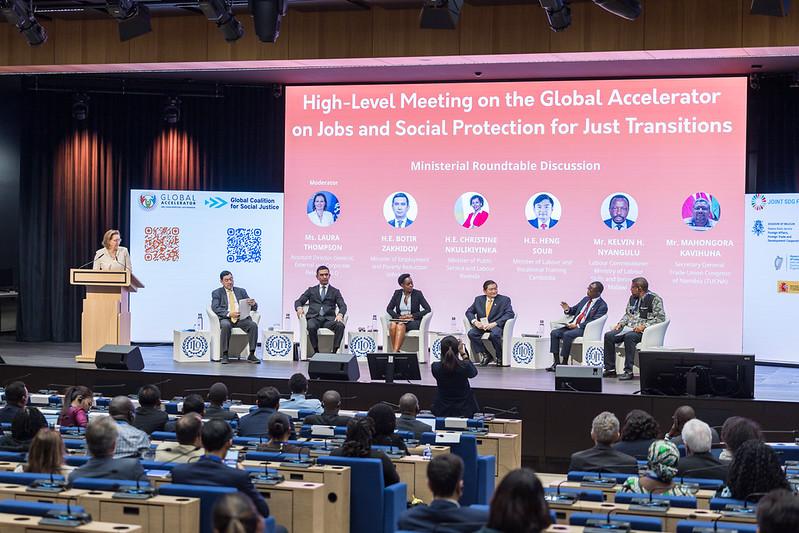
Geneva – At the sidelines of the ILO’s 114th International Labour Conference, Uzbekistan and Cambodia hosted a “High-level ministerial meeting on the Global Accelerator on Jobs and Social Protection for Just Transitions” with fellow pathfinder countries Malawi and Rwanda sharing their experience on the panel. During the discussion moderated by ILO’s Assistant Director-General, Ms Laura Thompson, the Ministers underlined the concrete impact of the initiative in their countries and called upon partners to continue championing it. The Global Accelerator Technical Support Facility also welcomed Zambia as the 20th pathfinder country and launched its recent publication titled, “Building the case for the Global Accelerator on Jobs and Social Protection for Just Transitions”, which documents how countries are using the Global Accelerator to achieve their broader development objectives. The event also reaffirmed the commitment of Global Accelerator pathfinder countries and partners to global exchange of experience and good practices.
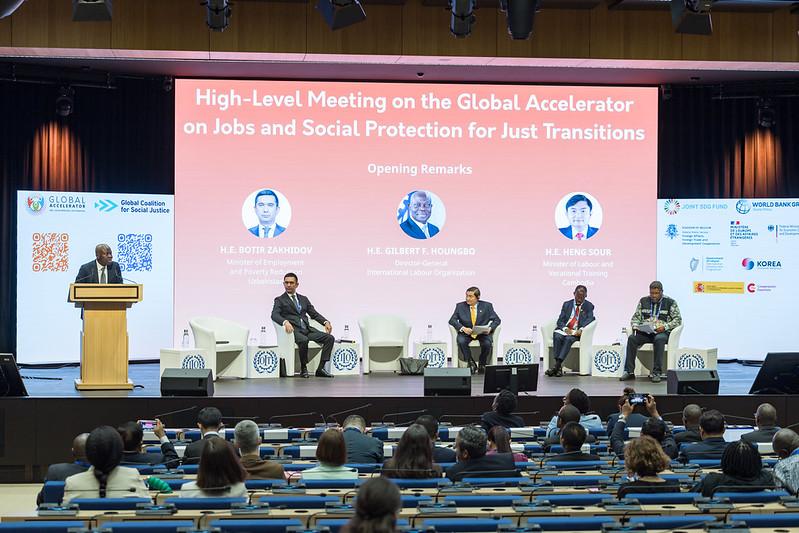
ILO Director-General, Mr Gilbert F Houngbo, opened the meeting by emphasizing the Global Accelerator’s relevance in helping countries respond to the multiple transitions shaping labour markets today, including demographic shifts, technological transformation, and climate change, that impact economic development. “The Global Accelerator’s pathfinder countries are united in their conviction that there can be no sustainable economic development and no green and digital transition without social justice,” he emphasized. During the discussion, countries highlighted a number of common challenges and how they are responding to them.
Uzbekistan and Malawi have furthered their policy and legislative reforms, in a bid to strengthen their decent work and social protection systems. The Global Accelerator aligns with Uzbekistan’s 2030 strategy, which focusses on job creation, poverty reduction, developing human capital, and strengthening the social protection system. The country’s recently passed Social Insurance Law will extend maternity and sickness benefits to 5.8 million more people, and a newly established Social Insurance Fund will ensure the sustainability of the system. "We will continue expanding social protection coverage, creating sustainable and productive jobs and strengthening institutional capacity, including through digitalization," stated Mr Botir Zakhidov, Minister of Employment and Poverty Reduction, Uzbekistan, regarding the country’s way forward with the Global Accelerator.
Malawi has developed a new Workers’ Compensation Bill that, once passed, will extend legal protection to more than 4.2 million workers. In conjunction, the country is working on the creation of decent jobs through the development of Technical and Vocational Education and Training (TVET) programmes in horticulture and dairy sectors, the commercialization of agriculture, certifying skills with the recognition of prior learning, while also giving over 1000 women financial literacy and business development support, to strengthen the labour market. “The Global Accelerator has helped Malawi move beyond traditional policy silos by linking employment, skills development, productive sectors, and social protection within a coherent framework supported by national coordination mechanisms,” mentioned Mr Kelvin H. Nyangulu, Labour Commissioner of Malawi.
Skills development, in particular related to green and digital skills and Artificial Intelligence (AI), is a priority across countries. Cambodia is accelerating a TVET programme that targets 1.5 million youth from poor and vulnerable households and provides them with free-of-charge training and cash benefits to cover living expenses during their training. Highlighting the importance of modernising labour market information systems, and preparing workers for the opportunities and challenges brought by digitalization and AI, Mr Heng Sour, Minister of Labour and Vocational Training of Cambodia, explained how the Global Accelerator contributes to advancing on the Sustainable Development Goals (SDGs): “The Global Accelerator's areas of action are closely linked to some of the most important Sustainable Development Goals, including decent work, poverty eradication, gender equality and climate action. Advancing this agenda is critical to accelerating progress towards the 2030 Agenda.”
A recurring theme throughout the discussion was the importance of formalization as a pathway to decent work, social protection and productivity growth. Rwanda’s second national strategy for transformation identifies the creation of 1.25 million decent and productive jobs by 2029. Contributing to this goal, the Global Accelerator national roadmap of Rwanda refers to formalization as a key priority in the agribusiness sector, manufacturing and creative industries, and the digital economy. “Ultimately, success is not measured solely by the number of jobs created, but by people’s ability to participate in growth with security, dignity, and opportunities. This is the promise of the Global Accelerator, and Rwanda remains fully committed to making it a reality,” said Ms Christine Nkulikiyinka, Minister of Public Service and Labour, Rwanda.
All speakers referred to the importance of ensuring a just green transition.
In most developing economies, Micro-, Small and Medium Enterprises (MSMEs) are responsible for generating a majority of the employment. These enterprises are also some of the most impacted by climate change, with 40 per cent of the labour force engaged in jobs that face climate risk. Employers play a crucial role in anticipating the skills needs of the future by identifying the requirements of the labour force early and supporting reskilling. A just transition is one, that is not only green, but also prioritizes social dialogue, to ensure that transitions are more predictable, inclusive and effective, for enterprises and workers alike. “The Global Accelerator isn't a peripheral issue but rather at the heart of what enterprises do - creating jobs, sustaining livelihoods and generating economic opportunities,” stated Mr Farooq Ahmed, Secretary General, Bangladesh Employers’ Federation.
The Global Accelerator, by including social partners in its core structure and governance mechanisms, has helped ensure that workers have an equal voice and representation in the processes that decide the future of work. The ILO’s leadership of the initiative helps ensure that social dialogue remains central, even when engaging with actors who have less experience with tripartism, as put forward by Mr Mahongora Kavihuha, Secretary General, Trade Union Congress of Namibia (TUCNA).
The meeting was closed with the launch of the Global Accelerator’s latest publication, “Building the case for the Global Accelerator on Jobs, Social Protection and Just Transitions” by Ms Valérie Schmitt, Deputy Director of the Universal Social Protection Department of the ILO. The publication captures how the pathfinder countries are using the Global Accelerator’s framework to further their ambitions, while also featuring examples of systems from some non-pathfinder countries that can be adapted by the Global Accelerator pathfinder countries. Pathfinder countries are continuing to develop and implement their national priorities around job creation and the extension of social protection with the support of 47 UN and UN-World Bank joint programmes, with 10 further programmes under development. Pathfinder countries can also directly request further technical assistance through the Hub of Expertise.