
Cambodia strengthens capacity for policy simulation through SMSD training under the Global Accelerator
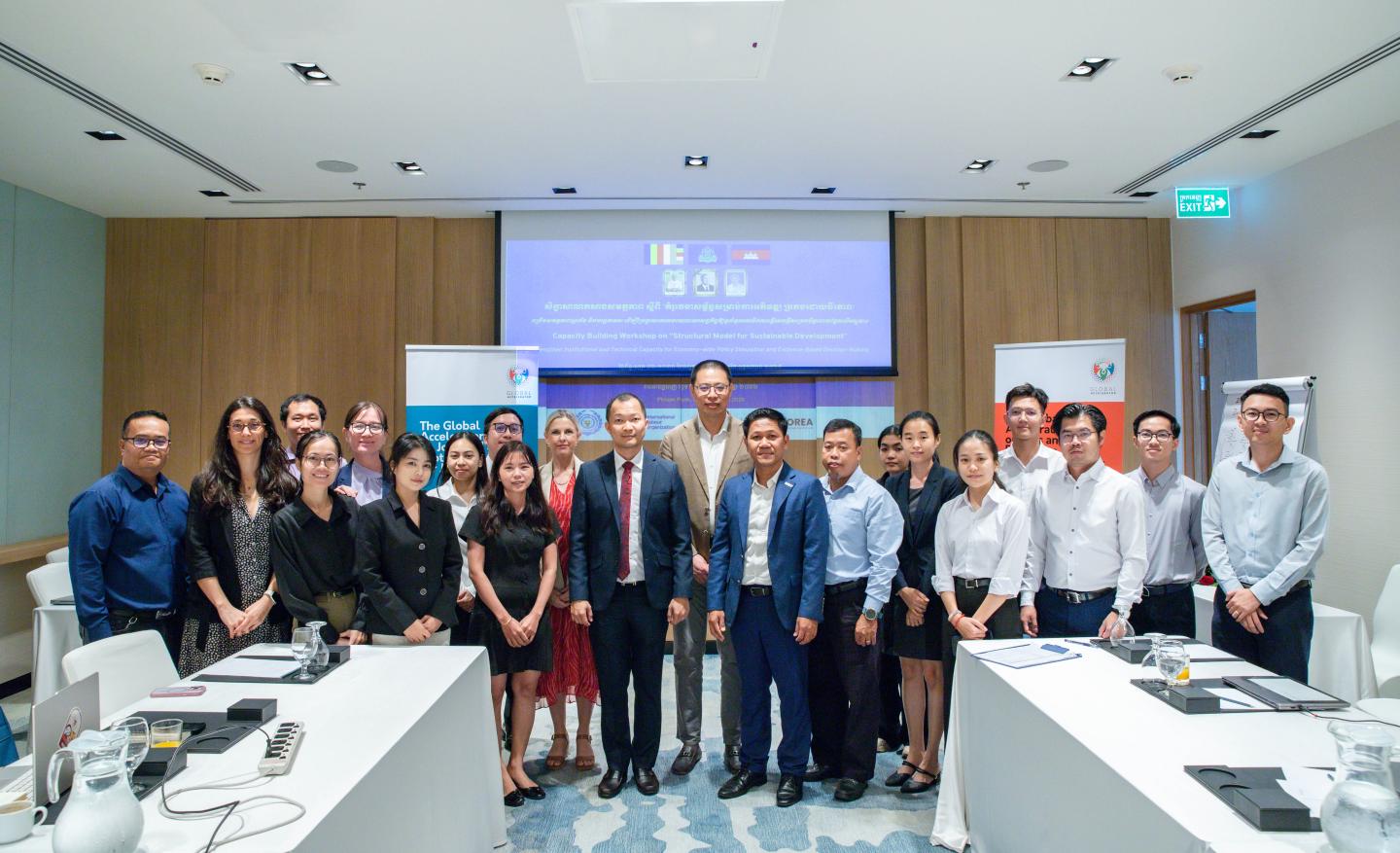
Phnom Penh, Cambodia – A week-long training on the Structural Model for Sustainable Development (SMSD), which forms part of Cambodia’s engagement under the Global Accelerator, brought together officials from key institutions to strengthen national capacity for economy-wide policy simulation and ex-ante impact assessment of employment and social protection policies, from 9-13 March.
Through its Technical Support Facility (TSF), the Global Accelerator supports countries in strengthening analytical tools and institutional capacities needed to assess policy options, inform reform processes, and promote integrated approaches to decent job creation and social protection expansion. In this context, the SMSD provides an economy-wide modelling framework that links macroeconomic dynamics with labour market and household outcomes. The model enables ex-ante simulations of policy scenarios, allowing policymakers to assess the potential employment and social protection impacts of national development plans, policy reforms, public investments and projects supported by international financial institutions.
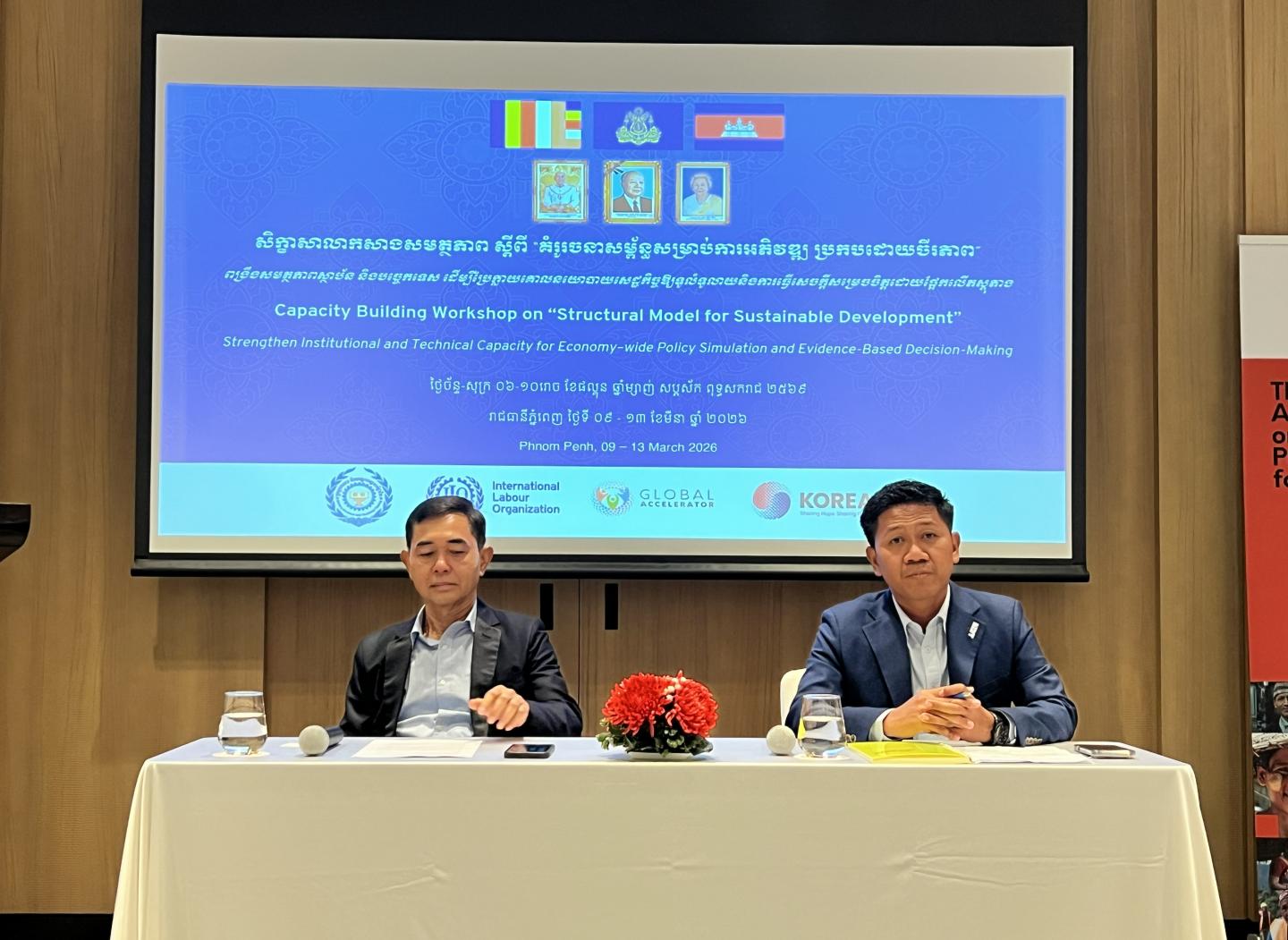
Under the leadership of the International Labour Organization (ILO), the TSF has developed a capacity-building programme to support Global Accelerator pathfinder countries in strengthening their capacity to conduct ex-ante policy simulations and impact assessments to inform employment and social protection policies using SMSD. The programme follows a learning-by-doing approach, combining technical training with applied research aligned with the priorities identified in national Global Accelerator roadmaps.
Cambodia joined the Global Accelerator as a pathfinder country in 2023 and subsequently developed a national road map, aligned with the government’s Pentagonal Strategy. As implementation of the roadmap advances, strengthening the analytical foundations for policy design and assessment has become increasingly important.
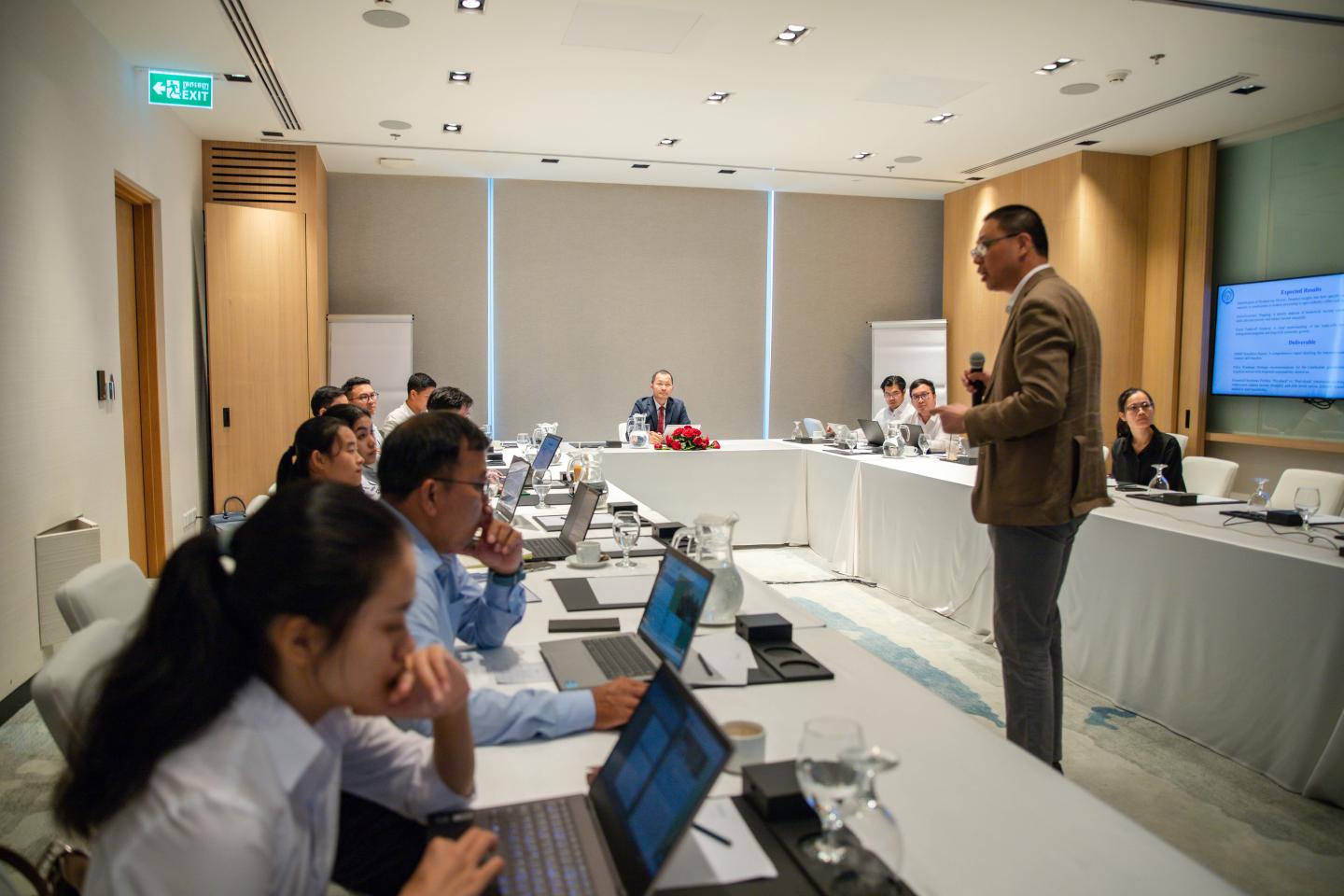
Responding to the Ministry of Labour and Vocational Training’s request to strengthen its analytical capacity to assess the employment, and social protection impacts of potential policy scenarios and investment operations the first in-person training took place from 9 to 13 March in Phnom Penh. The training was designed and delivered by Mr Xiao Jiang, Finance and Economic Development Specialist, ILO. Participants included officials from the Ministry of Labour and Vocational Training (MLVT), the Ministry of Economy and Finance (MEF), the National Social Security Fund, the General Secretariat of the National Social Protection Council, and the National Institute of Statistics.
The training programme was opened by Mr Sophorn Tun, National Coordinator,, ILO Cambodia, and Mr Sopheana Bronh, Secretary General, General Secretariat of the National Council for Minimum Wage, Ministry of Labour and Vocational Training. Speaking at the opening, Mr Tun noted that the six-month programme, implemented by the ILO under the Global Accelerator’s TSF, is intended as an institutional investment to strengthen Cambodia’s analytical capacity to inform policy decisions. He emphasized that the initiative aims to strengthen political decision-making with quantified evidence by supporting the development of a national SMSD model, strengthening capacity across key institutions, and generating applied research aligned with the priorities of Cambodia’s road map.
During the week, which marked the first in-person module of a six-month capacity-building and applied research programme, participants explored the foundations of economy-wide modelling including input–output analysis, supply-use tables and social accounting matrices before moving on to the construction of a prototype SMSD model. The module ended with an in-depth introduction of Neural Network Machine Learning as a microsimulation technique. Over the coming months, the programme will support the development of a fully operational SMSD for Cambodia and the production of applied research outputs addressing key policy priorities.
Two applied research papers are planned for development as part of the programme. The first will analyze the macroeconomic, employment and distributional impacts of global trade shocks due to tariff imposition and LDC graduation on Cambodia’s economy, with particular attention to how shocks affecting export sectors propagate through supply chains, labour markets and household groups. It will also look into potential macroeconomic, sectoral and social protection policies to mitigate the risks identified earlier. The second will examine the employment and income effects of reintegration policies for returning migrants, including sector-targeted vocational training, skills certification and social protection measures such as reintegration cash transfers, and how these interventions influence labour market outcomes, productivity and household welfare.
The training concluded with remarks by Ms Mary Kent, Skills and Employability Specialist, ILO, and Mr Kuoch Somean, Secretary of State of the Ministry of Labour and Vocational Training. In his closing remarks, Mr Somean emphasized the importance of advancing integrated approaches to employment, social protection, and economic policy under the Global Accelerator. He stressed that stronger evidence-based policymaking, supported by tools such as SMSD, is key to advancing these efforts.
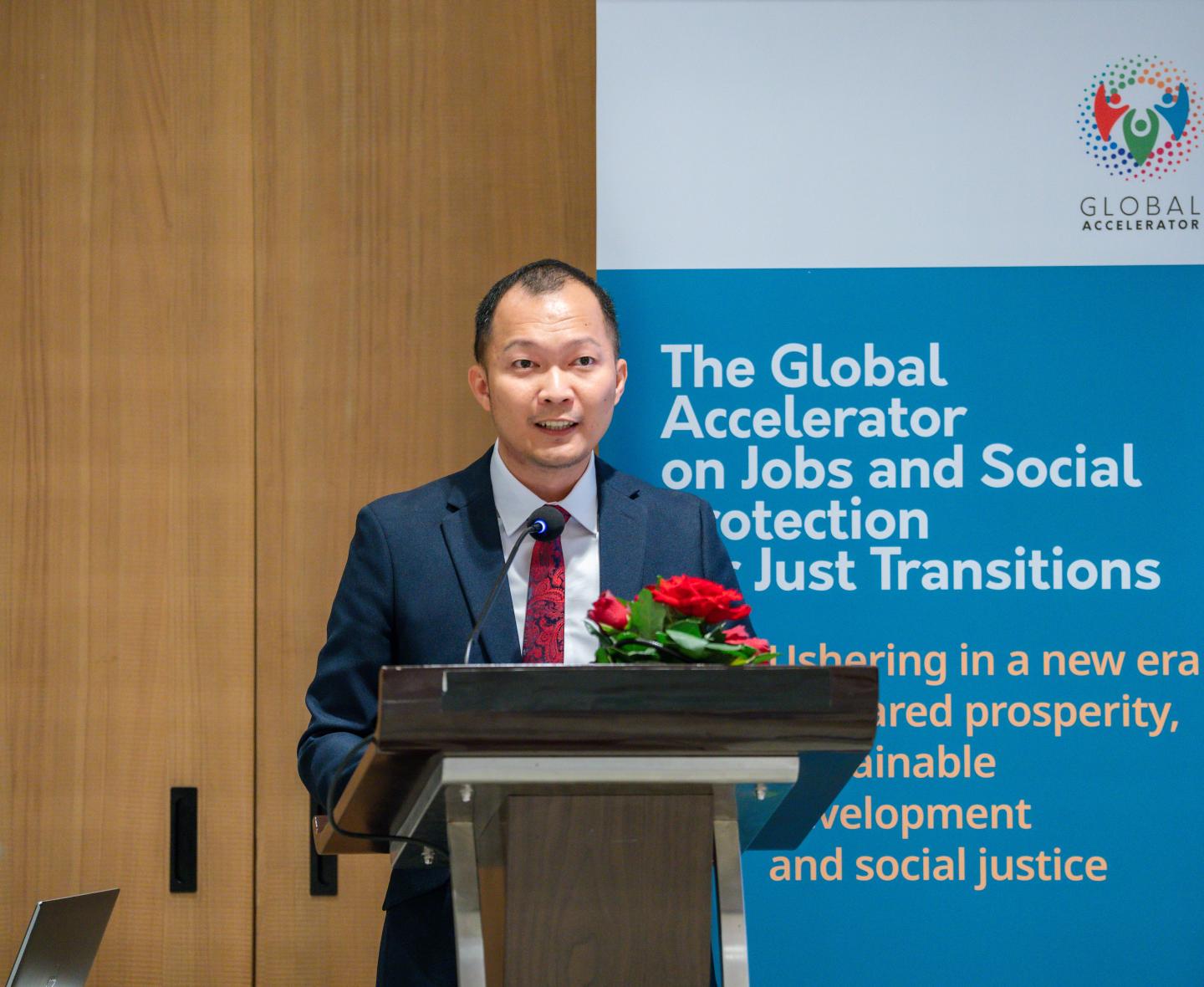
“The Global Accelerator promotes a more integrated approach to employment, social protection, and inclusive economic transformation. Rather than addressing these issues separately, it encourages countries to consider how job creation, skills development, social protection, and economic policies can reinforce one another. For Cambodia, this integrated perspective is particularly important. Our development pathway increasingly requires stronger coordination between economic growth strategies and social outcomes. Strengthening analytical capacity — including tools such as SMSD — will help us better understand these interactions and design policies that support both productivity and inclusion. The training we have completed over the past week therefore, represents an important step toward strengthening Cambodia’s national analytical capacity.”
This capacity-building programme is implemented by the ILO under the Global Accelerator’s Technical Support Facility, with financial support from the Government of the Republic of Korea. The support contributes to the implementation of the Global Accelerator in pathfinder countries by strengthening national capacities to design integrated employment and social protection policies, including stronger linkages with active labour market policies and skills development.