
Global Accelerator showcases importance of integrating jobs and social protection, gets featured in Doha Declaration at WSSD2
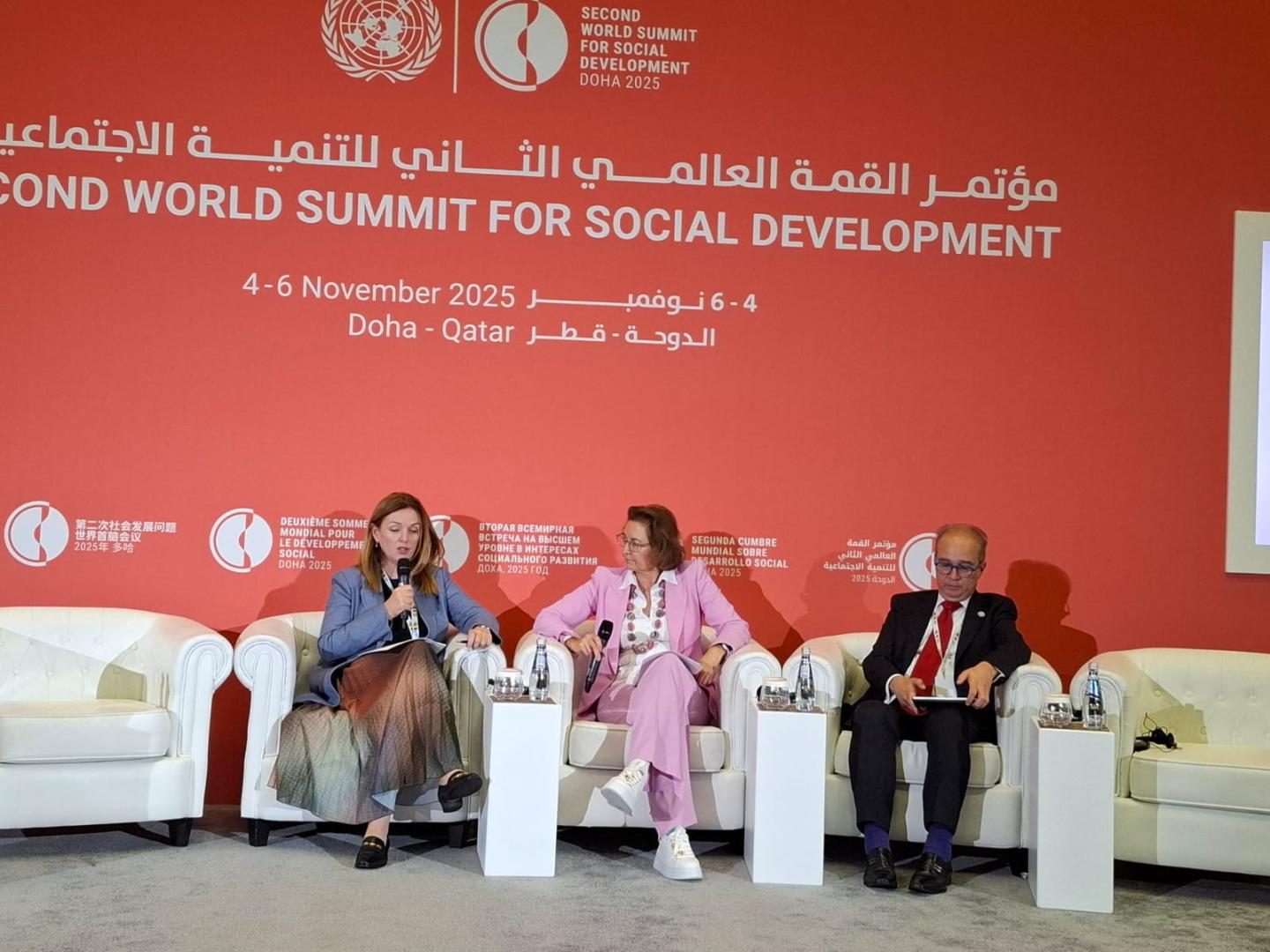
Doha, Qatar – The Global Accelerator on Jobs and Social Protection for Just Transitions had a broad presence at the Second World Summit on Social Development (WSSD2) in Qatar, from 3-6 November 2025. The Doha Declaration has recognized the Global Accelerator as a critical mechanism to implement the ambitions of the Declaration. Member States committed to consider supporting the implementation of the Global Accelerator, as encapsulated in the commitments of the Doha Political Declaration (paragraph 30 h). Beyond the recognition, the Global Accelerator was also present across several key events, to share insights on financing, policy pathways and scaling reforms for decent jobs and universal social protection.
The NGO Committee on Financing for Development hosted its Solutions Session “Turning Global Commitments into Local Impact: Financing for a Just and Inclusive Transition” on 3 November. The session touched upon evidence-based solutions to align financing frameworks with people-centred priorities and clear pathways to create tangible improvements in incomes, services, and resilience. At the event, the Global Accelerator highlighted how the Sevilla Commitment, the outcome of the Fourth Financing for Development Conference (FfD4), set ambitious targets for social investment and the rethinking required of financing frameworks, to support inclusive, social development.
With only 52.4 per cent of population having access to social protection, there is not a single solution that will close the coverage gap – integrated approaches are needed. Contributory schemes still provide the largest share of coverage (35 per cent), as per the ILO’s World Social Protection Dashboard, but these systems face challenges to reach those in the informal economy, or workers in non-wage labour relations. To tackle the coverage gaps, new approaches to reach to these workers and collect contributions are required, but keeping with the principles of solidarity in social security, and ensuring that schemes cater to the needs of the population. Mr André Bongestabs, Specialist on Financing at the Global Accelerator, underscored how the initiative is reducing fragmentation across policy and financing and enabling countries to move forward in an integrated manner.
“Addressing the multiple and complex challenges we face to create decent jobs, extend social protection and support just transitions require integrated and coordinated approaches. Isolated solutions and actions will not be sufficient. We must strive to work together and build joint visions for integrated employment and social protection policies that place people and solidarity at the centre of the national development agendas,” stated Mr Bongestabs in his remarks.
The Global Accelerator hosted its virtual Solutions Session “Country-led solutions: Integrating decent jobs and social protection for social development” on 4 November, as part of the ongoing Second World Summit for Social Development (WSSD2). The event showcased how countries, donors, and international financial institutions are aligning policy and financing to scale reforms for decent jobs and universal social protection.
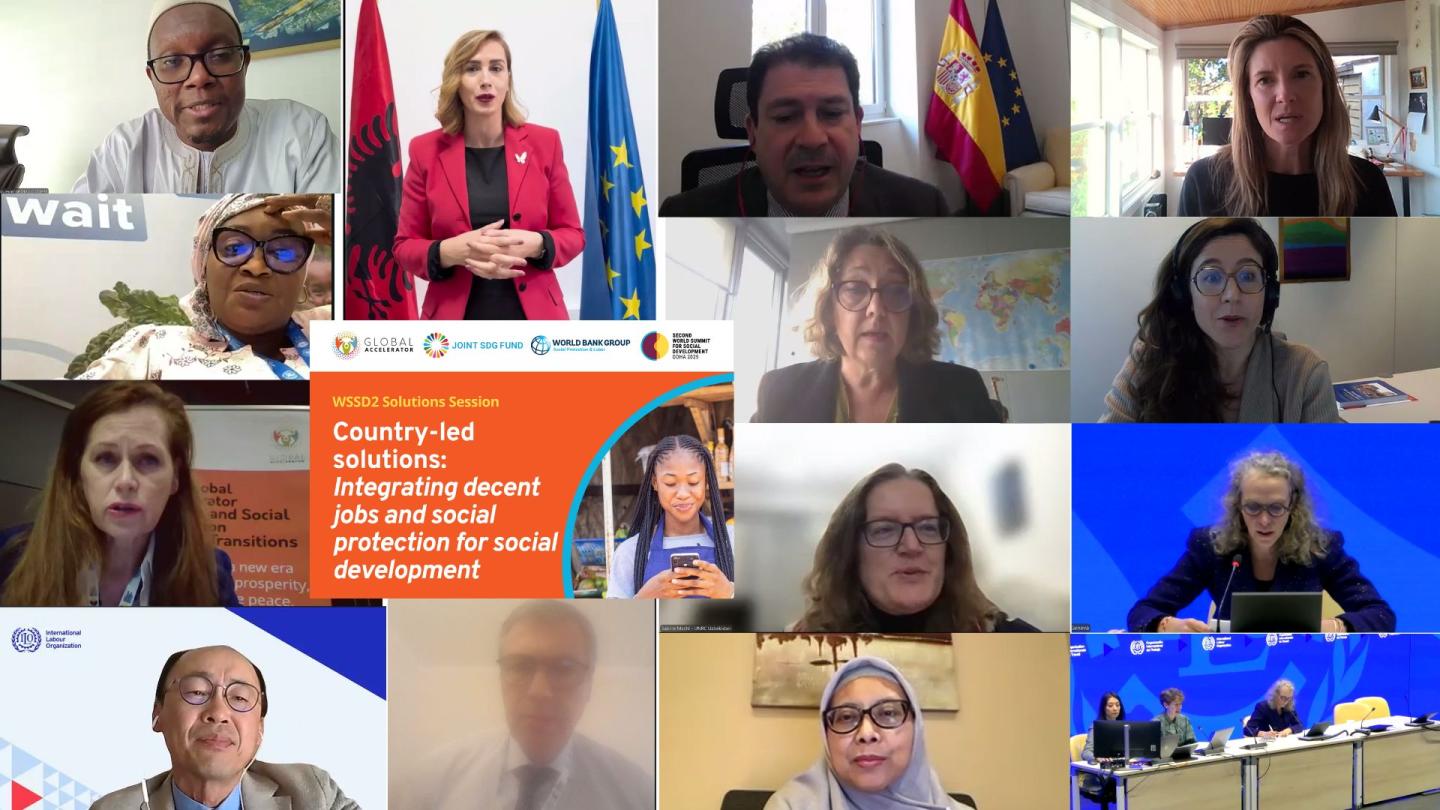
The Global Accelerator supports all three core themes of social development – eradicating poverty, promoting full and productive employment and decent work for all, and fostering social integration – simultaneously.
Ms Olta Manjani, Deputy Minister of Economy, Culture and Innovation, Albania stated that by embedding social commitments into fiscal planning, the country was ensuring more equitable access to government services such as education, health, employment support, and social protection. “Albania's message today is clear. Investment in decent work and social protection is not a cost, but a catalyst that enhances productivity, strengthens social cohesion, boosts labour market participation”, she stated in her remarks.
The event showcased the different approaches that Albania, Indonesia, Senegal and Uzbekistan, are employing, as Pathfinder Countries, for integrating decent jobs and universal social protection. It also brought together technical and financial partners to highlight how they are combining their support in a coordinated and complementary manner for mobilizing and aligning resources to support country-led reforms.
Read more about the event here.
The Joint SDG Fund hosted its Solutions Session “Policy Pathways to Inclusion: Advancing Human Rights through Social Protection and Decent Work” on 5 November. The high-level event spotlighted four countries, including two Global Accelerator Pathfinder Countries – Malawi and Uzbekistan, are leading the way in advancing a human rights economy through integrated UN joint programmes tailored to their national priorities of productive employment, decent work, social integration and poverty eradication.
As part of framing the Human Rights Economy as a key element of the Global Accelerator for Jobs and Social Protection, Ms Laura Thompson, Assistant Secretary-General, ILO, highlighted the transformative and multiplier effects of extending social protection and creating decent employment.
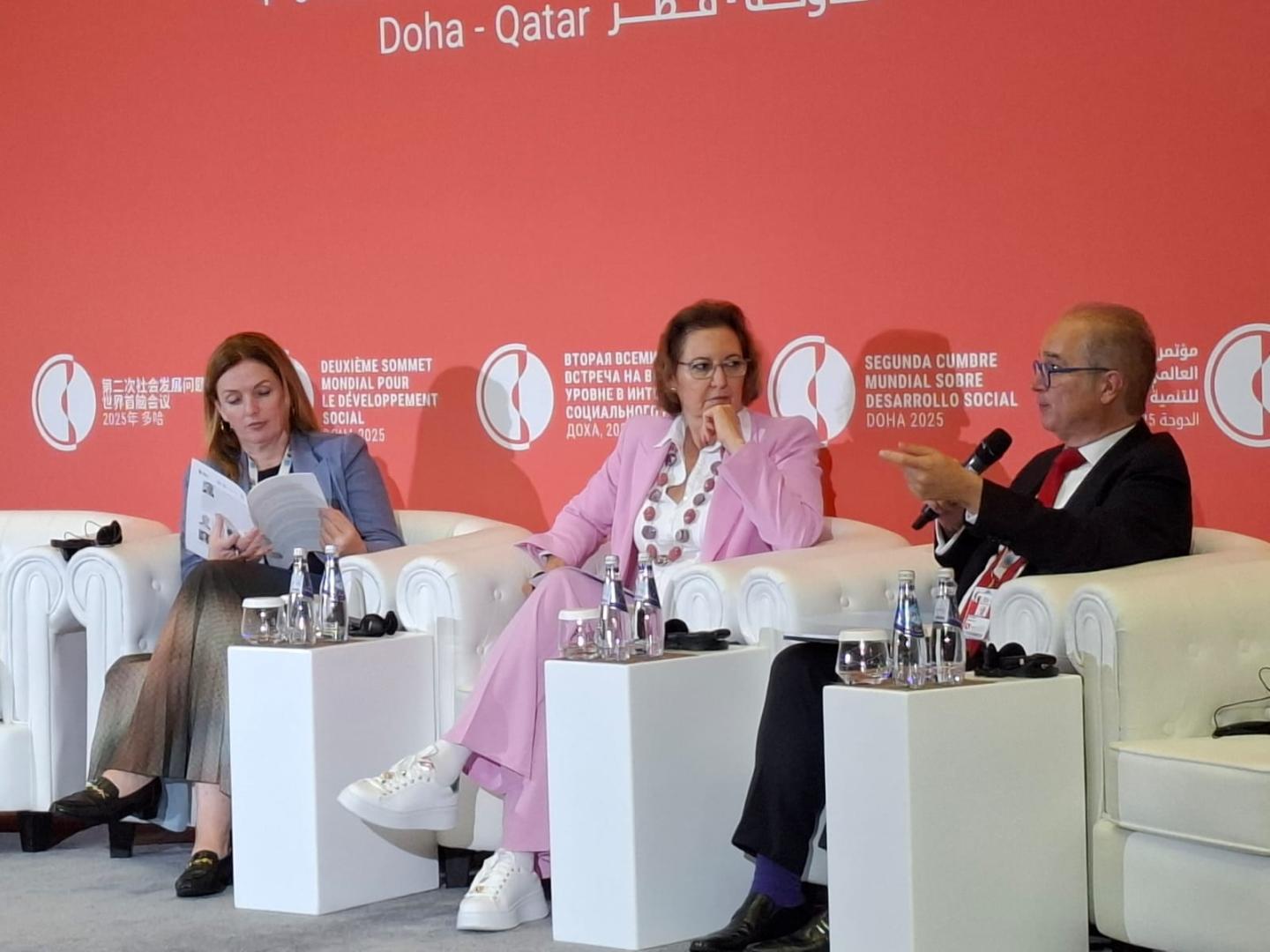
“By putting the human rights economy at the heart of its approach, the Global Accelerator is linking high-level macroeconomic guidance with practical programmes and financing tools that deliver tangible impacts for social and economic development,” she noted in her intervention.
The strategic relevance of the Global Accelerator for gender equality was also highlighted at the solutions session on “Closing Gender Gaps Across the Life Course From First Job to Secure Retirement” organized by UN Women together with the Governments of El Salvador and Morocco. At the session, the UN Resident Coordinator for Nepal, Dr. Hanaa Singer-Hamdy noted how UN Women's and ILO's work on the care economy under the Global Accelerator supports women's labour force participation and sustainable pathways out of poverty across the life course.