
Namibia launches diagnostic of the informal economy and a draft policy framework to facilitate the transition to formality
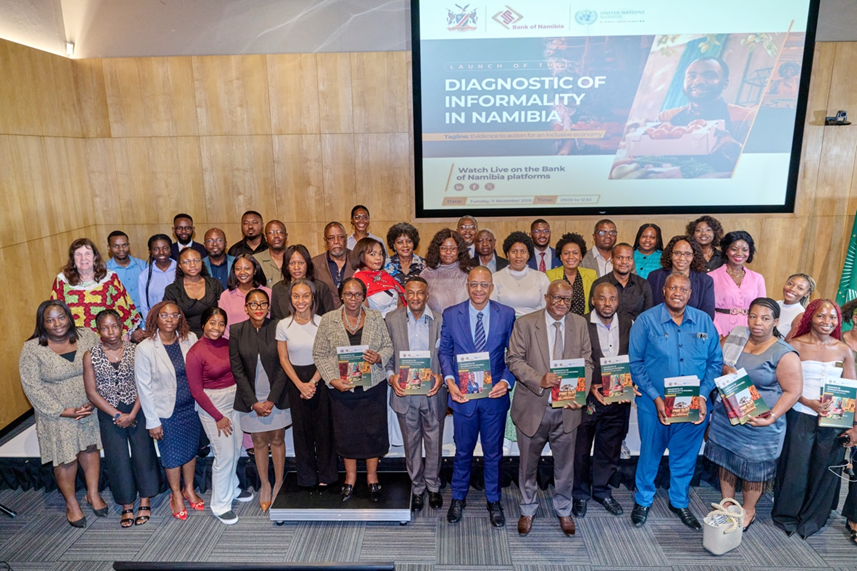
WINDHOEK, Namibia – A new diagnostic study has quantified Namibia’s informal economy at US$13 billion (PPP) for 2025, accounting for 26.5 per cent of GDP and employing 58 per cent of the national workforce. It reveals that most Namibian informal workers operate without social protection, access to finance, or secure working conditions, with social protection coverage at a stark 0.69 per cent.
The comprehensive diagnostic of the informal economy together with a draft policy framework and roadmap to facilitate the transition from the informal to the formal economy was launched by Namibia on 11 November 2025, as part of the Global Accelerator. This launch marked a major step toward strengthening national policy responses for one of the country’s largest economic segments. The conclusion of this work, which was initiated in 2023, provides an evidence base for strengthening policies and institutions supporting informal workers and enterprises.
The work to undertake the analysis and develop a policy framework launch was jointly led by the Bank of Namibia, the Ministry of Industry, Mines and Energy, and the Ministry of Justice and Labour Relations, in collaboration with several government offices, ministries and agencies. The United Nations in Namibia, through the Resident Coordinator’s Office, the ILO, UNDP and UN-Habitat, provided financial and technical support as part of the work under Global Accelerator for Jobs, Social Protection and Just Transitions. Workers’ representatives, employer organisations and informal-economy associations contributed throughout the process.
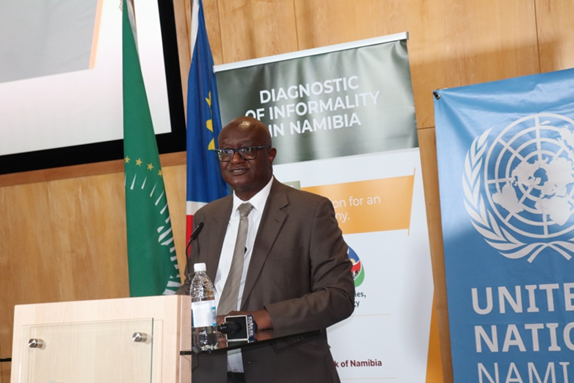
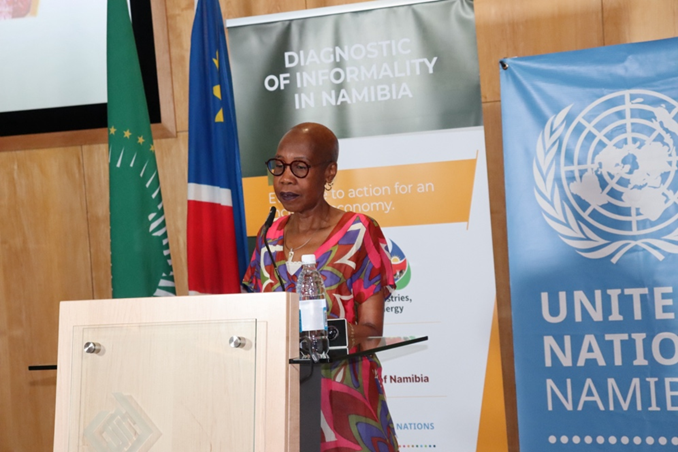
Speaking at the launch which was themed, “Evidence to action for an inclusive economy,” Dr Michael Humavindu, Executive Director of the Ministry of Finance, said, “this sector is not a side economy; it is a pillar of our national life," he added that, "Namibia cannot transition to shared prosperity while half its workforce transitions daily between survival and exclusion." At the same event, Ms Hopolang Phororo, United Nations Resident Coordinator for Namibia, underscored the importance of moving decisively from analysis to delivery. She noted, “Let us commit not just to analysis, but to action. Let us build a Namibia where every job has value, every worker has rights, and no one is left behind.” She emphasized that implementation would define the success of the reforms, adding, “As we embark on the journey of implementing the recommendations of this Diagnostic, together, may courage, clarity and boldness guide us towards coordinated action and pooling of resources.”
Three documents were launched. First, the overview report synthesising the national trends, economic contributions and the structural conditions shaping informality. Second, a sectoral analysis report which provides a detailed assessment of informality in Agriculture, Fishing and Forestry, and in Food and Accommodation Services. This report identifies specific drivers, vulnerabilities and productivity constraints, proposing targeted interventions to enhance livelihoods and support a gradual transition to formality. The third document, is the draft policy framework and roadmap which outlines an integrated strategy for formalization between 2026 and 2035, built on eight strategic objectives ranging from reducing decent-work deficits and enhancing social protection to strengthening institutional coordination and promoting inclusive digitalization.
The Government and the United Nations, through the Global Accelerator for Jobs, Social Protection and Just Transition will now move to the implementation of the plan of action - outlined in the roadmap and draft policy framework, ensuring that reforms translate into stronger protections, expanded economic opportunities and more resilient livelihoods.