
From roadmaps to results: Steering Group advances the next phase of the Global Accelerator
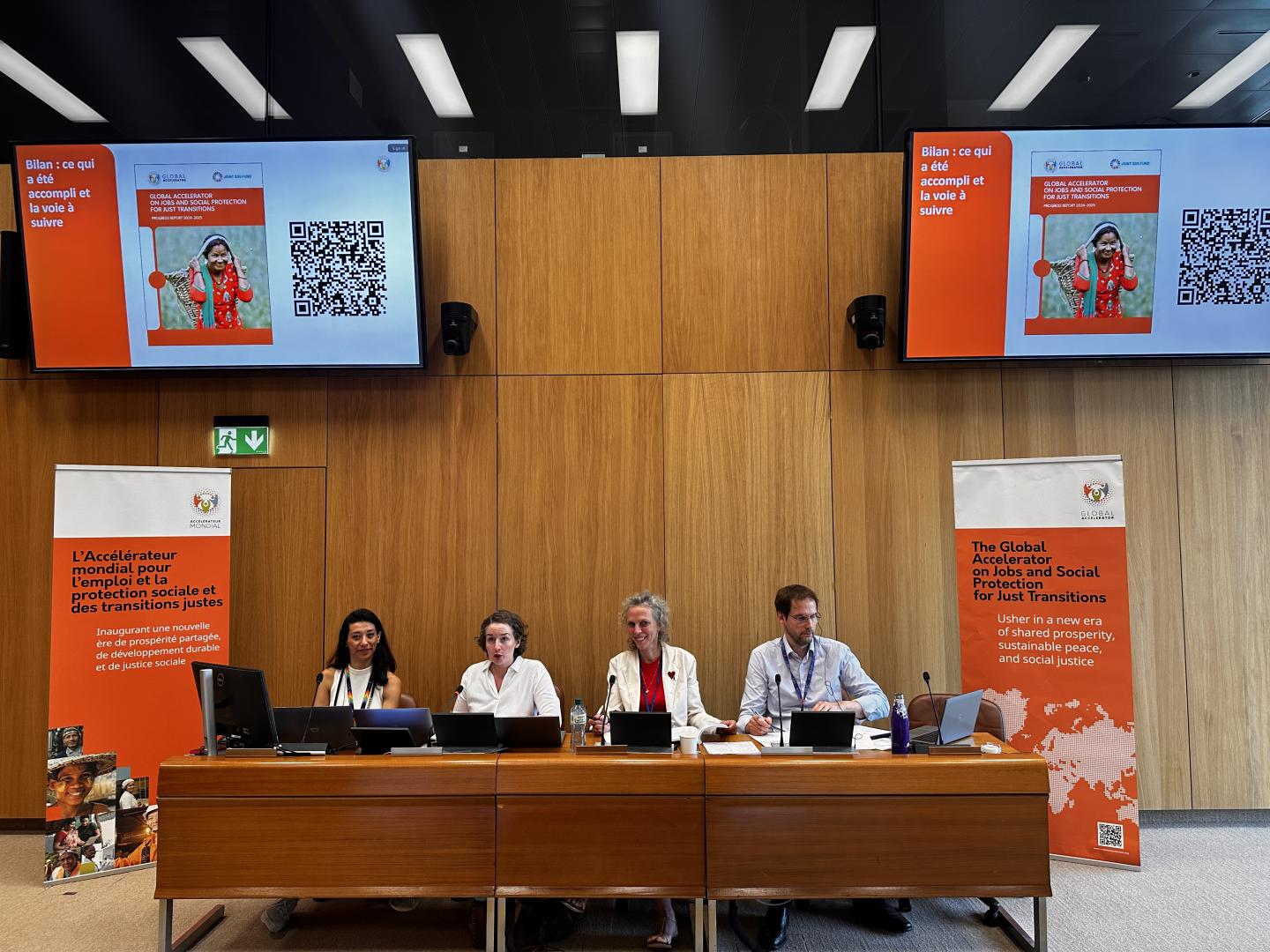
Geneva - The eighth Steering Group meeting of the Global Accelerator on Jobs and Social Protection for Just Transitions took place on 30 June 2026 with the participation of the representatives of pathfinder country governments, workers and employers organizations, donors, UN agencies and civil society organizations.
The Steering Group welcomed Zambia as the 20th Pathfinder country. Linking to the previous Steering Group's focus on youth, Zambia highlighted the importance of creating jobs, expanding social protection and addressing skills mismatches for young people. The Steering Group also welcomed the Major Group for Children and Youth as a new member, emphasizing the need to engage young people throughout the policy cycle and strengthen the link between global discussions and local action as well as the link between youth-led organizations and governments, development partners and UN agencies.
Progress in implementing the Global Accelerator was presented through two new publications: Building the Case for the Global Accelerator, which captures countries' strategic vision and implementation pathways - this is about “how” the Global Accelerator is being implemented-, and the Progress Report, which focuses more on the “what” by documenting the tangible results the countries have achieved in the last 1.5 years.
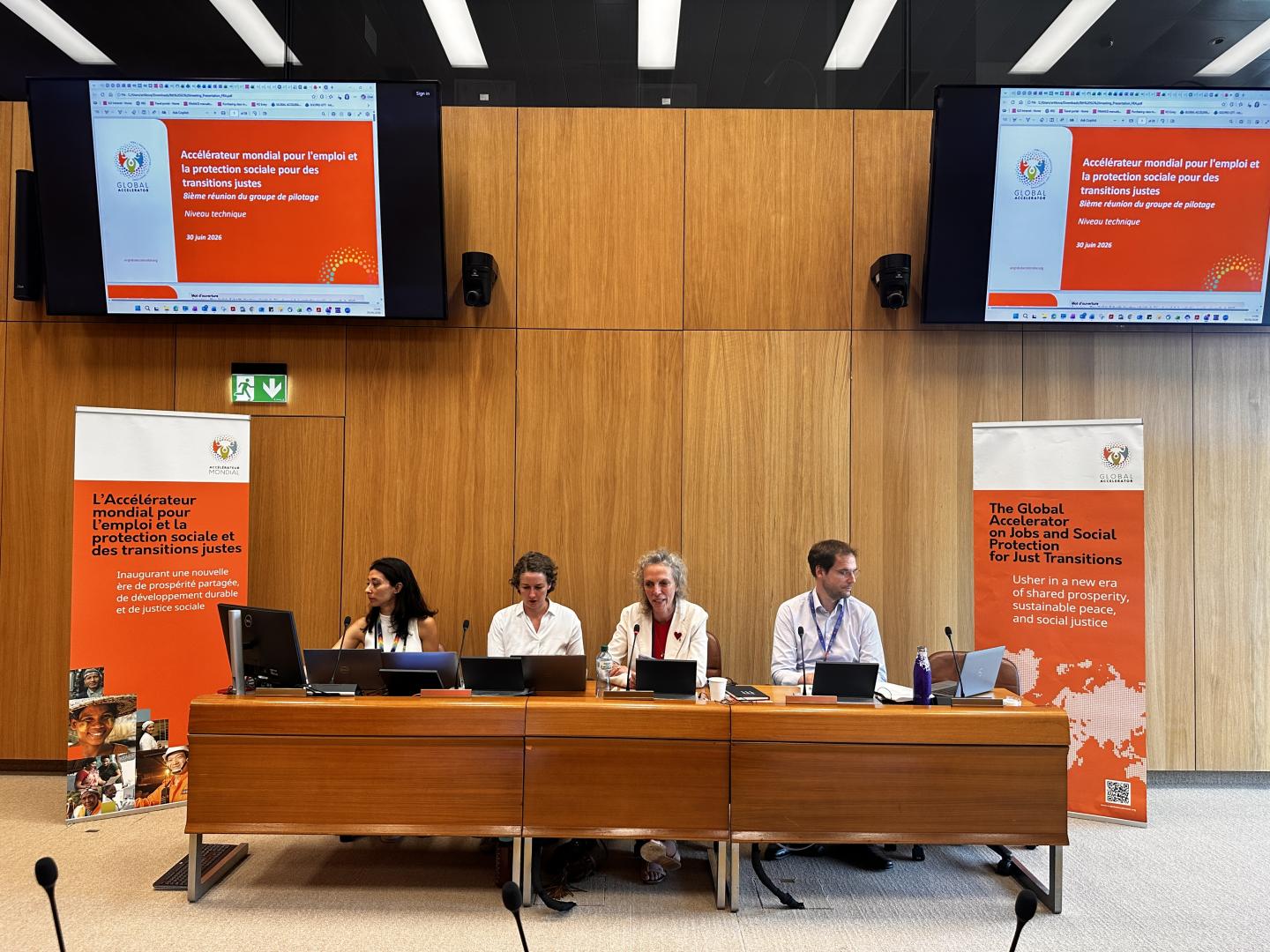
The insights from these publications were substantiated by pathfinder countries, as they shared how they have moved from commitment to action, with the initiative thus far.
Mr Benetus Nagombe, Executive Director, Ministry of Justice and Labour Relations, Namibia, highlighted how the Global Accelerator directly addressed the country’s challenges on joblessness, inequality and exclusion: “We did not wait for the roadmap to be perfect…We started with two catalytic joint programmes…Our ongoing reforms mirror the Global Accelerator's goals…Our third employment policy has moved towards adoption, and the Labour Act is being amended to widen and expand social protection,” he stated.
The Global Accelerator has also been the initiative that was “in the right place, at the right time”, as it brought together the ambition, the expertise and the initiatives that were operating in silos, to the same table. This was illustrated by Mr Arnaud Peral, UNRC in the Philippines, who highlighted, “There are two things that we don't lack, the national ownership and vision, and international community engagement...So, when the Global Accelerator came, we already had the framework, policy, and vision...it helped us address fragmentation and the disconnection”.
An update on the emerging results against the indicators of the Global Accelerator Results Framework underscored that strong government leadership and investment in national monitoring systems are essential to demonstrate results, support learning and strengthen implementation.
Another key agenda item focused on the two upcoming funding rounds and the technical support that will accompany them through the Technical Support Facility.
The Seed-to-HIT funding round is supporting seven pathfinder countries in moving from roadmap development to implementation through High-Impact UN Joint Programmes, with a stronger emphasis on sustainable financing, national ownership and leveraging at least six dollars of additional investment for every dollar of catalytic funding. As Dr Pukar Malla, Honourable Member of the National Planning Commission of Nepal, noted, the High-Impact programme is "not a standalone project, but really a catalytic enabler that can strengthen larger investments, institutions, and systems."
The third M-GA funding round focuses on climate change and fragility contexts, with twelve shortlisted country programmes—including in four Pathfinder countries. The M-GA portfolio demonstrates how UN and World Bank support can be aligned with Global Accelerator roadmaps, national priorities and World Bank operations, strengthening financing, systems and institutions while creating stronger pathways to implementation and scale.
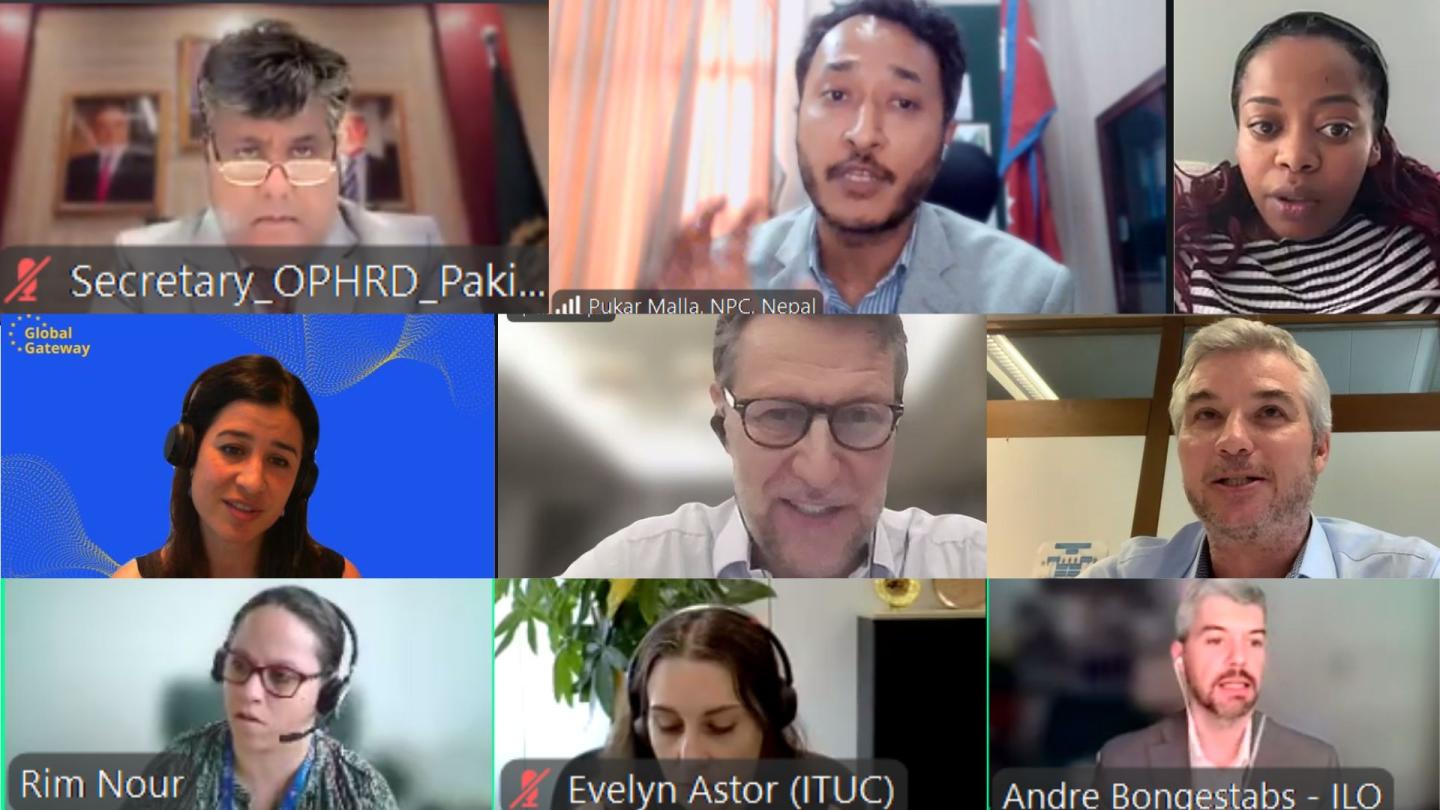
Steering Group members emphasized the need to strengthen advocacy and resource mobilization. The discussion confirmed that catalytic funding through the Global Accelerator is unlocking much larger domestic and international investments while supporting integrated policy reforms. Positioning employment and social protection as drivers of economic and social transformation creates a virtuous cycle in which stronger economic development reinforces stronger social development, and vice versa.
Walking the talk, Pakistan highlighted its commitment to the Global Accelerator by allocating domestic resources equivalent to four times the initial Joint SDG Fund investment,. “For the next financial year, Pakistan has allocated 1 billion Pakistani rupees or USD 3.6 million for the Global Accelerator, which is embedded with our broader economic strategy of Uraan-Pakistan,” added Mr Nadeem Aslam Chaudhary, Secretary, Ministry of Overseas Pakistanis and Human Resource Development, Pakistan, likening the “Uraan” or ‘flight’ in Urdu to the acceleration envisioned under the initiative.
Germany also reaffirmed its support for the Global Accelerator and M-GA, announcing a €10 million contribution for a fourth M-GA funding in 2027. The European Commission also reaffirmed its commitment to implementing integrated approaches based on Global Accelerator roadmaps in partner countries and strengthening collaboration with ministries of finance, development banks and other financing partners.
Representing workers, Mr Mahongora Kavihuha, ITUC commended the countries on their progress and encouraged more perspectives from the employers’ and workers' organizations, to ensure that “progress is not leaving anyone behind, and is embedded in the original principles of Global Accelerator.”
The meeting concluded by reaffirming the strong momentum behind the Global Accelerator and the Steering Group's critical role in providing strategic guidance for future funding rounds and continuing the roadmap implementation in pathfinder countries. Looking ahead, priorities for the coming year include:
- Continued and coordinated technical and financial support to pathfinder and M-GA countries to translate the high-level commitments made at the Second World’s Social Summit for Social Development and the Fourth International Conference on Financing for Development into integrated national reforms;
- Further mobilizing catalytic resources to support policy reforms and unlock significantly larger domestic and international financing to sustain implementation over the long term;
- Expanding the evidence base through new knowledge products, strengthened results reporting and a forthcoming cluster evaluation of the High-Impact portfolio;
- Fostering continued peer learning and engagement through key global events, including the High-level Political Forum, Asia-Pacific Social Protection Week, COP31 and the Finance in Common Summit.
Read: Global Accelerator Progress Report: 2024-25
Read: Building the case for the Global Accelerator on Jobs and Social Protection for Just Transitions