
Tripartite constituents in Uzbekistan discuss progress on new Social Insurance Law
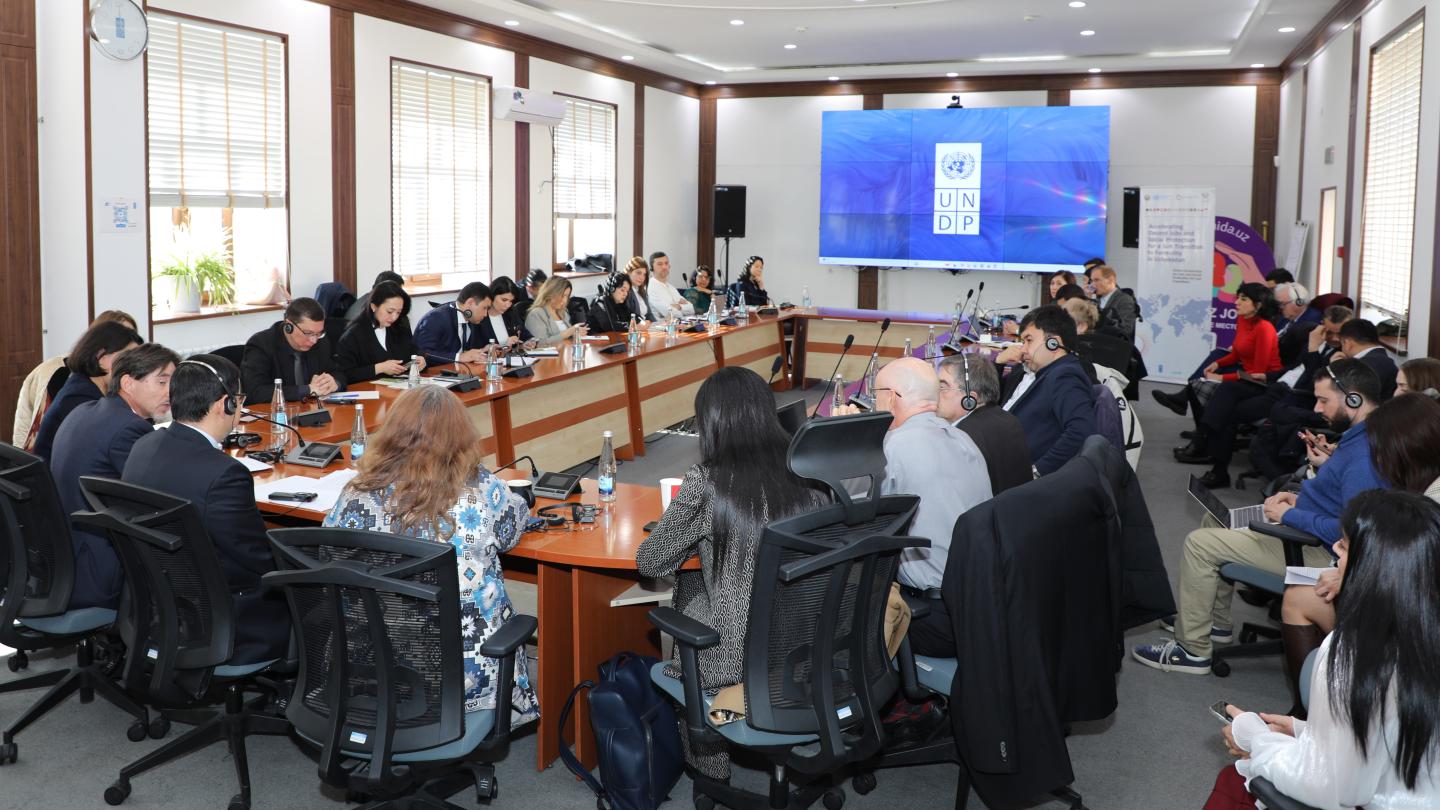
Tashkent, Uzbekistan – Government representatives, employers’ and workers’ organizations and international partners acknowledged progress in strengthening social protection with the adoption of Uzbekistan’s new Social Insurance Law and discussed next steps for its implementation at a tripartite round table organized by the International Labour Organization (ILO) in Tashkent on 3 February 2026.
The Law, adopted on 9 December 2025, followed by Cabinet Resolution No. 796 of 17 December 2025, establishes a state social insurance system with mandatory and voluntary coverage. Maternity benefits have been implemented since the 1 January 2026, while cash sickness benefits will start on 1 July 2026 and unemployment benefits will be introduced in 2030. These measures are intended to strengthen income protection for workers and their families during periods of illness, maternity and unemployment.
Jamshid Abruyev, Deputy Director of the National Agency for Social Protection, noted that the Law represents an important step in modernizing Uzbekistan’s social insurance system and expanding protection for workers and their families.
Around 50 national and international representatives participated in the event, led by the National Agency for Social Protection (NASP). Participants included representatives of the Ministry of Employment and Poverty Reduction, the Ministry of Economy and Finance, the Ministry of Health, the Federation of Trade Unions of Uzbekistan, the Confederation of Employers of Uzbekistan and the Chamber of Commerce and Industry. The UN Resident Coordinator (UNRC) in Uzbekistan, representatives of the ILO, UN Women, UNFPA, WHO, IOM, UNESCO, UNDP, UNICEF and other UN agencies also attended, alongside international financial institutions including the World Bank, ADB, KfW and GIZ.
Participants recognized that the new provisions on social protection are aligned with international labour standards. The introduction of contribution‑based mechanisms marks significant progress in strengthening risk pooling and collective financing while reducing reliance on employer‑liability schemes. The Law also aims to extend coverage to broader population groups – an important step toward universal social protection. In addition, it establishes a State Social Insurance Fund, with a key role for tripartite partners in its governance.
Speaking on behalf of the UN system, Ms Sabine Machl, UN Resident Coordinator in Uzbekistan, highlighted the strong partnership underpinning these reforms: “I am pleased to note that through the Global Accelerator Projects, the United Nations, together with partners such as the World Bank, has committed to supporting employment formalization and the expansion of social protection, working directly with NASP.” Machl emphasized the need for sustained commitment to ensure successful implementation of the law: “We are aware that this is a long‑term commitment, and I, on behalf of the UN, stand ready to continue supporting the implementation of the Law, creating every opportunity for UN teams and agencies to provide the best possible technical assistance to NASP.”
Several development partners, including GIZ and KfW, confirmed their intention to continue supporting NASP throughout the implementation phase of the Social Insurance Law.
Through the Global Accelerator on Jobs and Social Protection for Just Transitions, the ILO has supported the development of the Law and continues to contribute to actuarial assessments, by-law drafting and capacity building efforts to ensure effective implementation.