
Global Accelerator’s Community of Practice hosts first learning session on financing to further knowledge exchange among pathfinder countries
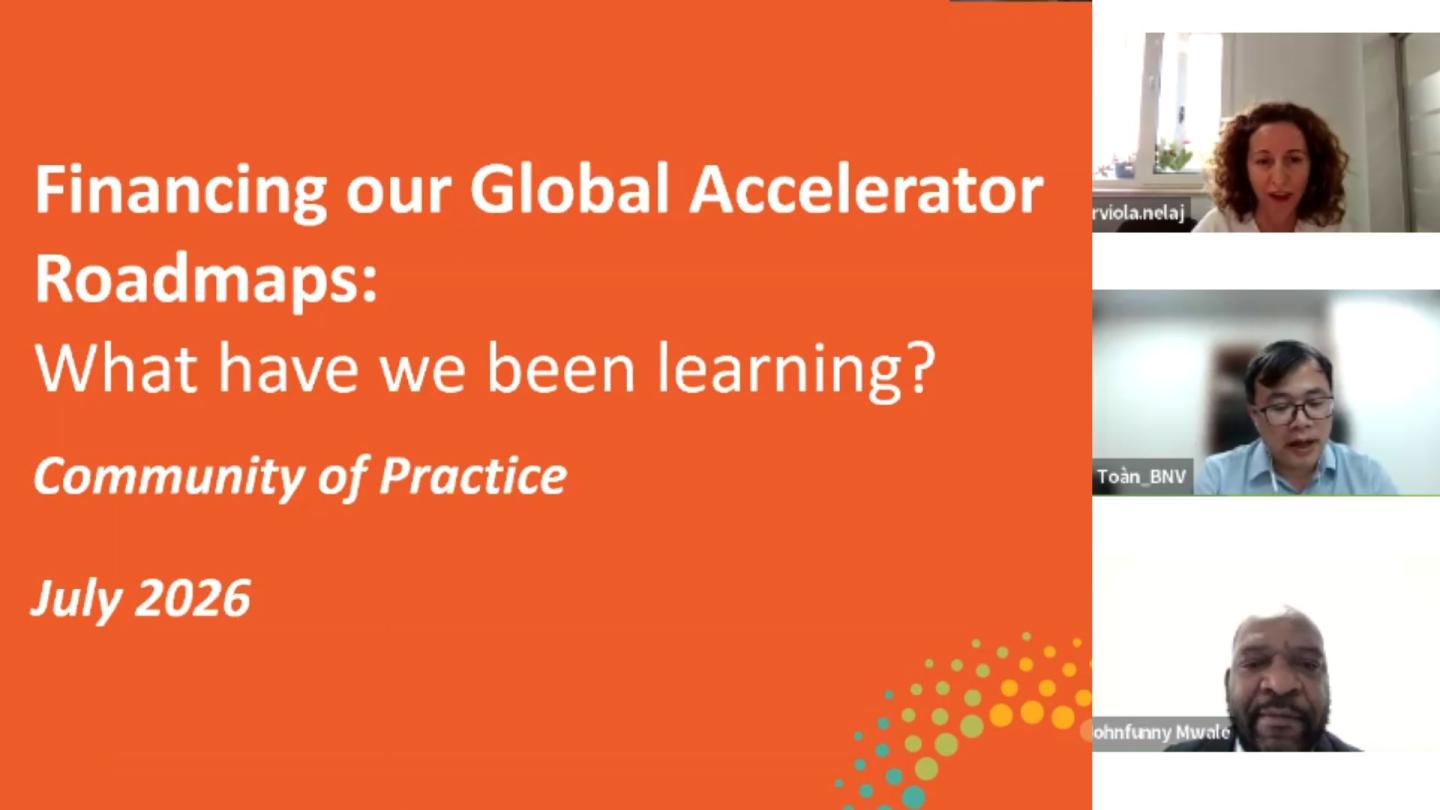
Geneva – The Global Accelerator’s Community of Practice held its first learning session on 22 July 2026, as a peer-to-peer clinic to facilitate knowledge sharing among pathfinder countries. As all pathfinder countries receive catalytic funding. which helps them leverage and mobilize further financing for their roadmaps, the first session aptly focussed on financing.
The Technical Support Facility of the Global Accelerator has developed the Guidelines for the Development of Financing Strategies for the Global Accelerator Roadmaps and the Thematic Roadmap on Financing Frameworks, which are the “theory” and the “strategy” to guide financing efforts under the initiative. A brief overview of these two documents provided the base for the session, as it encouraged community members to articulate the investment that would be required to implement their national roadmaps and where those funds would be unlocked from.
The financing strategy supports mobilization and allocation of resources to implement the roadmap's priorities around employment, social protection, and just transitions, while also linking it to national development plans, fiscal frameworks, and budget processes. It helps countries quantify and propose financing pathways for the different priority actions of their roadmaps and gives a common language to the otherwise diverse approaches on financing, employed by the decision-making institutions.
This was followed by three pathfinder countries sharing their experience on how they have “shifted” the dial, by taking action on public spending, public revenues, promoting investments with social impact, and enhancing macroeconomic and fiscal policies for jobs and social protection.
Dr Pam Goh Tuan, Director - Center for Information, Strategic Analysis, Forecasting, and Public Services at the Institute of State Organization, Viet Nam highlighted Employment and Social Protection Expenditure Reviews (ESPER), which is enabling the country’s “transition from more spending to better spending.” With ESPER, the country is able to use existing public resources more effectively, fairly, and strategically. The review is expected to enable a better understanding of current public expenditure, identify opportunities to improve correlation, improve efficiency and better understand future financing needs.
For Albania, one of the priorities is to improve expenditure tracking, in the face of competing budget priorities. Ms Erviola Nelaj, Chief of Social Assistance Unit in the Ministry of Health and Social Protection, Albania showcased how the country is using a mixed financing architecture that draws from the state budget, the social insurance fund, local and development partner financing, to improve its financing for the roadmap.
Mr Johnfunny Mwale, Principal Economist, Ministry of Economic Planning and Development, Malawi emphasized on foundational principle of the Global Accelerator, of employment and social protection expenditure of not merely being costs but powerful economic investments. He also highlighted how the country is forging strategic partnerships that unlock private and international capital and proving “with the right collaborative frameworks, clear financials, and a diversified financial strategy, national roadmaps can be successfully funded and sustained.”
Exchanges among the representatives explored mechanisms available to engage with different actors, thinking beyond traditional processes while also keeping sight of the gaps and challenges which need to be addressed, like data fragmentation and coordination. The session reinforced the importance of internalizing the discussions on financing within the government and institutionalizing the existing mechanisms into policy discussions and government structures, to meaningfully move the needle forward.
The Community of Practice will host more such sessions in the latter half of the year to encourage peer learning across pathfinder countries and build a stronger network that champions the Global Accelerator’s ambitions.