The Multistakeholder Engagement to Implement the Global Accelerator on Jobs and Social Protection for Just Transitions and the World Bank Social Protection and Jobs Compass (M-GA) is a partnership between the United Nations and the World Bank to accelerate progress to achieve universal social protection and create decent and productive employment.
This joint initiative was initiated in 2023 with the support of the German Federal Ministry of Economic Cooperation and Development (BMZ), later joined by the Governments of Ireland and Spain, aiming to support countries to develop integrated and well-coordinated national employment and social protection programmes and policies.
The UN Global Accelerator and the World Bank’s Social Protection and Jobs (SPJ) Compass both aim to forge concerted action among international partners, strengthen national ownership and apply a systems approach, to social protection, decent and productive job creation.
As a joint mechanism of the UN and World Bank, the M-GA is supporting increased collaboration and collective action, under national leadership, and with coordinated support from the UN agencies, World Bank, development banks, and existing platforms such as the Global Partnership on Universal Social Protection (USP2030), as well as other relevant partners.
The M-GA aims to achieve five development objectives, namely:
The M-GA receives donor contributions, which are allocated equally between two funding windows: the UN Joint SDG Fund and the World Bank’s Social Protection Response (SPR) Umbrella Trust Fund. These resources finance joint country programmes, global knowledge products, and the operations of the M-GA Management Team. Further details are provided in the Governance and Funding sections.
The M-GA offers country partners a single point of entry, supported by harmonized diagnostics, programming, and funding. By fostering closer collaboration between the UN and the World Bank, the M-GA further enables coordinated technical assistance, strengthening the operational support delivered by the World Bank and the UN.
There have been two funding calls under the M-GA for joint UN-WB projects.
The first call was in 2024, and nine Global Accelerator pathfinder countries were selected to implement projects with USD 500,000 funding for two years. The implementation of the projects started in Q4 2024.
Country proposals from the first funding round focused on the following themes:
The second call was launched in May 2025, with a more ambitious scope, under two tracks.
In this funding round, proposals were equally required to demonstrate how they would achieve either gender-responsive and gender-transformative outcomes, specifically targeting the gaps and barriers present in their countries.
Under the second call, 23 proposals, including one multi-country proposal have been selected to get funded for two-year joint programmes.
Here’s a closer look at what the second round funded:
The funding round placed emphasis on gender integration in the proposals, with six joint programmes pursuing gender equality as a principal objective.
Regional distribution of the nine countries selected under the first M-GA funding call.
Regional distribution of the 23 proposals selected under the second M-GA funding call.
The map shows the countries where M-GA projects are being implemented. Click on the dots for more information.
The project contributes to the eradication of extreme poverty through skills development, especially for women and youth not in education, employment or training. It also aims to enhance productivity of micro-businesses and the self-employed in rural areas, and support for formalization of informal micro-businesses. Read more
Implementing agencies: ILO, UNDP, World Bank
The project builds human capital of poor and vulnerable persons through an evaluation of social assistance delivery, with the aim of reform and improvement, ensuring that TVET responds to employer needs, and evaluating TVET delivery on cross-cutting skills to complement digital skills initiatives. Read more
Implementing agencies: ILO, UNICEF, World Bank
The project aims to increase social protection coverage, adequacy, and systems adaptability, in particular for youth and women, through an analysis of pathways towards social protection extension and their respective impacts on poverty and inequality reduction. Two municipal pilot programs will be implemented to integrate all social protection programs. Read more
Implementing agencies: UNICEF, WFP, World Bank
The project contributes to increasing inclusion and reducing the vulnerability of persons with disabilities through a cost-of-care assessment of raising a child with a disability. Additionally, the project will deliver capacity building on employment services provision for working age persons with disabilities, a training delivery assessment for persons with disabilities, an institutional and process review of social protection programs for persons with disabilities, and an analysis of needs for elderly persons with disabilities. Read more
Implementing agencies: ILO, UNICEF, World Bank
The project enhances productivity and access to social protection for women, youth and informal workers through improved coordination and capacity development on integrated policies for key stakeholders. It will support evidence generation on productivity, working conditions, MSMEs, skills development, and climate change impact on employment. Read more
Implementing agencies: ILO, UNICEF, World Bank
The project contributes to redesign and implementation of the social protection system and active labour market policies. It aims to improve labour market access of youth and women; enhance the governments’ capacity to identify skills gaps, anticipate impacts of technological and climate change; design a lifelong learning strategy, and engage in national dialogue on pension system reform. Read more
Implementing agencies: ILO, UNDP, World Bank
The project contributes to reforms of the employment and social protection systems, with a focus on construction and transportation sectors, through identifying and evaluating pathways for increased government financing for decent jobs and social protection. This includes increased social climate finance, developing sector-specific skills development programs, reviewing the unemployment protection system, analysing options for social protection extension to gig and platform workers, and strengthening social protection monitoring and evaluation. Read more
Implementing agencies: ILO, UNICEF, UNDP, World Bank
The project contributes to the extension of social protection, in particular social insurance, through the development and implementation of the Social Insurance Law. The project will conduct analysis of the design and financing of maternity, sickness and unemployment benefits, and build capacity of the national social protection agency to assess social insurance design options. Read more
Implementing agencies: ILO, UNICEF, World Bank
The project aims to improve the gender-responsiveness of labour market measures for the green transition and enhance social protection systems. It focuses on assessing occupations and skills needs for renewable energy, developing a gender-responsive career development tool for transitions to green jobs, and evaluating the impacts of key policy reforms on coverage expansion and contribution behaviour. Additionally, it analyses policy options to support workers and discourage lump-sum social insurance withdrawals while exploring ways to strengthen the social protection system to integrate climate considerations.
Implementing agencies: ILO, UNDP, World Bank
Joint work on global level is aiming to support joint knowledge generation, analysis, synthesis, and dialogue at the global level to fill gaps in practice, evidence and understanding, contributing to the objectives of the M-GA and its implementation.
Funds are being used to develop and pilot evidence-based global tools and develop knowledge products at the global level that can help increase coverage, improve adequacy, flexibility, opportunity, and financing of social protection and jobs.
See below examples of the joint UN and World Bank global projects.
Labour market programmes and activation measures are essential to promoting decent jobs and universal social protection, particularly in developing countries where unemployment and precarious work prevail. Active labour market programmes (ALMPs), combined with social protection measures, feature prominently in Global Accelerator pathfinder country roadmaps and M-GA projects, helping disadvantaged groups access better opportunities.
However, global data on ALMPs primarily focuses on high-income countries. To address this, the ILO and World Bank are aligning methodologies and coordinating data collection, prioritizing Global Accelerator pathfinder and developing countries. This initiative is expanding high-quality, comparable data on ALMPs, improving policy formulation, implementation, and monitoring.
The following activities are being undertaken:
As countries work to reduce GHG emissions, protecting poor and vulnerable populations from climate change impacts is critical. Social protection systems are recognized as key to climate adaptation and disaster response but are less explored in enabling households to adapt their livelihoods, resource use, and service access to mitigate risks.
The World Bank and UNICEF are working together to (i) enhance social protection systems to help vulnerable households reduce climate risk exposure, including slow-onset events, and (ii) build an investment case for social protection as a climate action policy using relevant metrics.
Key outcomes include:
The following activities are being undertaken:
Globally, only 52.4 per cent of the population has access to social protection, with large disparities between rural and urban areas, with a significant proportion of those not covered, relying on agriculture for their subsistence. At least 12 GA pathfinder or M-GA countries, which have included the transformation of the agrifood sector as a priority of their roadmap and/or joint programs.
FAO, ILO and the World Bank will collaborate to develop a practical guidance package, based on country experience, to support governments, social partners and other non-state actors in pathfinder countries and beyond, to design solutions for extending social protection for decent and productive jobs in the agrifood sector in rural areas.
The following activities are being undertaken:
A standard module on social protection for Labour Force Survey (LFS) and Household Income and Expenditure Survey (HIES), will be developed and piloted, as a collaboration between the ILO and the World Bank, with technical collaboration with UNICEF.
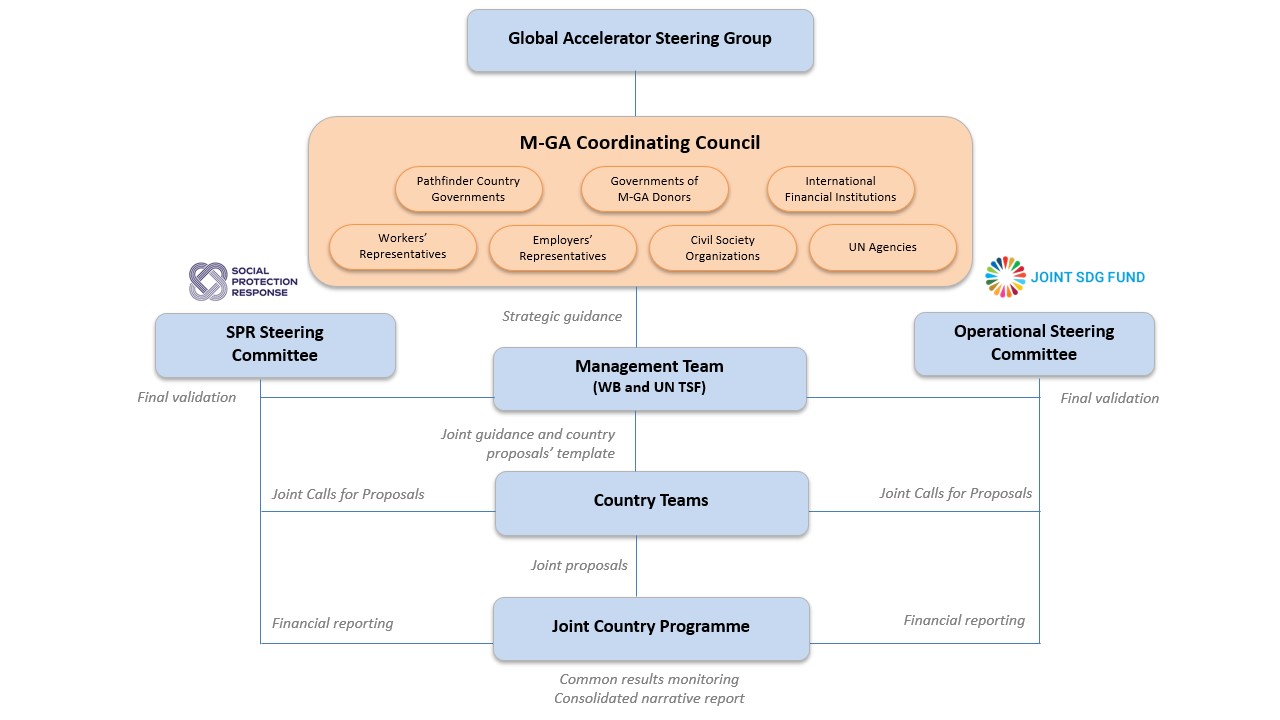
The M-GA Coordinating Council provides strategic guidance on M-GA engagements, including country support through calls for proposals and technical assistance, the development of global knowledge products and tools, and coordination with the GA Steering Group, while ensuring alignment with the objectives of the GA, the WB SPJ Compass, and the relevant Administration Agreements It comprises M-GA donors, UN agencies, IFIs, pathfinder countries, social partners, and civil society, and coordinates closely with the GA Steering Group.
The Management Team (MT), including ILO, World Bank, FAO, UNDP, UNICEF, UN WOMEN and WFP, support the Joint SDG Fund and the World Bank Social Protection Umbrella Trust Fund to design calls for proposals, organize technical reviews, monitor implementation progress, consolidate results and impact, and coordinate the development of global products. At the country level, joint activities are guided by existing coordination structures involving government, social partners, and civil society as well as UN agencies, World Bank and other development partners as relevant.
Read more on Coordinating Council Meetings.
By supporting the M-GA, development partners help countries increase social protection coverage and overcome decent and productive employment gaps while strengthening multi-stakeholder partnerships.
To date, the M-GA has mobilised approximately USD 44.7 million in joint UN–World Bank financing across two funding rounds, providing a clear indication of the scale of this innovative mechanism and the strong demand from countries. This financing has supported 32 joint UN–World Bank country programmes and four global knowledge products, approved under the M-GA funding calls and focused on common priority themes identified by participating countries, with the global products designed to directly inform and support country-level implementation.
For the third M-GA funding round, resources will be delivered through the World Bank’s Social Protection Response (SPR) Umbrella Trust Fund, which will engage participating UN agencies to implement joint country-level activities. This round is supported by a USD 17.5 million commitment from BMZ.
Building on this momentum, the M-GA aims to expand its scope to additional countries and thematic areas and to mobilise further resources to scale its impact at both country and global levels.
With sincere appreciation to the Governments of Germany, Ireland and Spain for their commitment and financial support for the M-GA.