
Turning commitments into impact: Global Accelerator report highlights progress across 19 countries
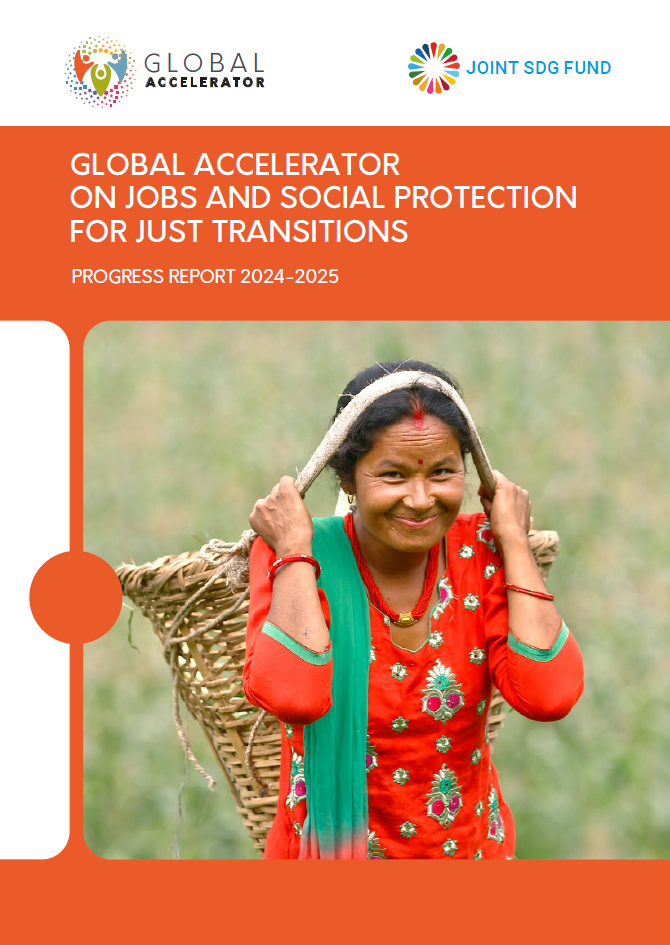
Geneva – The Global Accelerator on Jobs and Social Protection for Just Transitions launched its second progress report for 2024-2025, during its eighth Steering Group meeting on 30 June 2026, documenting a period in which the initiative moved decisively from design to implementation. As countries continue to navigate overlapping crises, from climate change and demographic shifts to informality, inequality and increasingly constrained fiscal space, the report showcases how governments across 19 pathfinder countries and their partners are using the Global Accelerator to place decent jobs and social protection at the centre of national development pathways.
Since the publication of the first Progress Report, the Global Accelerator has continued to grow as a country-led platform bringing together governments, the United Nations system, development partners, international financial institutions, employers' and workers' organizations, civil society and other stakeholders to advance integrated policy and financing solutions for employment, social protection and just transitions. The report showcases progress across the initiative's pathfinder countries, highlighting policy reforms, national roadmap implementation, strengthened governance mechanisms and social dialogue, technical cooperation and increased investments supporting country priorities.
Key highlights:
- Five new countries joined the initiative as pathfinder countries – Bhutan, the Democratic Republic of Congo, Guinea, Pakistan and Tunisia – reflecting a growing demand for integrated approaches for employment, social protection and just transitions.
- 19 pathfinder countries advanced integrated employment and social protection reforms through country-led national roadmaps:
o Albania, Bhutan, Cambodia, Indonesia, Malawi, Paraguay and Uzbekistan endorsed their roadmaps, while Senegal’s roadmap was technically validated.
o Cabo Verde, Colombia, Namibia, Nepal, the Philippines and Rwanda, advanced work to finalize and launch their national roadmaps in 2026. - Expanded financing and partnerships, including two joint funding rounds, through the Joint SDG Fund and the World Bank to support 47 integrated UN and UN-World Bank joint country programmes.
o In 2024, the first funding round initiated through the Joint SDG Fund and a complementary M-GA funding round helped launch the first 23 joint programmes across 14 pathfinder countries.
o In 2025, the second funding round for the M-GA initiated an additional 23 joint programmes and one global project, across 12 pathfinder and 12 non-pathfinder countries. - Strengthened technical support through the Technical Support Facility (TSF), mobilizing expertise from across the UN system and partners to respond to country demands.
- Country-level results demonstrating progress in creating decent jobs, extending social protection, promoting skills development, supporting formalization and advancing just transitions:
o Uzbekistan established a new Social Insurance Law that will extend social protection coverage to an additional 5.8 million persons.
o Malawi drafted a new Workers’ Compensation Bill, that will extend legal protection to more than 4.2 million workers.
o Cambodia initiated a social assistance linked TVET programme that is targeting 1.5 million youth from poor and vulnerable households, to provide them with social benefits that support the successful completion of the training.
o Paraguay created an additional 250,000 jobs in three years, reaching nearly half of the government’s target of 500,000 jobs by August 2028.
o Albania introduced and designed a Universal Child Benefit scheme, to promote child well-being outcomes, which the government has anchored in its National Social Protection Strategy 2024-2030. - Growing global recognition for the Global Accelerator in key international outcomes, including the Fourth International Conference on Financing for Development (FfD4), the High-Level Political Forum on Sustainable Development (HLPF), the G20 and the Second World Summit for Social Development (WSSD2) in para 30h.
- Breaking down silos for greater impact, demonstrating how integrated action across employment and social protection policies, collaboration between ministries, and joint support from the UN system and the World Bank are helping countries deliver more coherent and effective reforms, supported by UN Resident Coordinators and by the Technical Support Facility of the initiative.
Moving forward, the Global Accelerator will continue to support countries in advancing their priority reforms and turning commitments into concrete action. Its ambition is to make decent jobs and universal social protection a reality for more people, through integrated reforms and targeted investments. Achieving this will require strong social dialogue, effective partnerships, and sustained political commitment.
At the same time, the Global Accelerator will measure and document results and impact, building a compelling narrative that demonstrates what works and helps mobilize greater technical and financial support. It will also translate implementation experience into practical knowledge, enabling more countries to accelerate integrated reforms for decent jobs, universal social protection and just transitions.
Read the full Global Accelerator Progress Report 2024–2025 here.