
Policy and institutional change
More coherent policy packages, stronger legal and institutional frameworks and greater capacity to design and implement integrated approaches.
The Global Accelerator provides a common framework for helping countries tackle some of today’s most pressing development challenges. Its Theory of Change explains why integrated policies, sustainable financing and strong partnerships are needed to address interconnected challenges and ensure that major economic, environmental, technological and demographic transformations lead to more decent jobs, greater social protection and more inclusive outcomes.
Its implementation approach translates this vision into nationally led action.
Many countries are confronting persistent development challenges while navigating major transformations that are reshaping economies, labour markets and societies.
Millions of people remain excluded from decent and productive employment and adequate social protection. Widespread informality continues to limit access to rights, protection and economic opportunities.
At the same time, insufficient investment in jobs, skills, social protection and productive transformation — often compounded by constrained fiscal space and high debt — limits countries’ capacity to close these gaps.
These challenges are unfolding alongside profound digital and technological, climate and environmental, and demographic transformations. These transformations can create new jobs, productivity gains and development opportunities, but they can also disrupt livelihoods and deepen existing vulnerabilities.
The effects of these transformations are not distributed equally.
Poor households, informal workers, women and young people, MSMEs, populations affected by transitions and other vulnerable groups can face particular barriers to accessing new opportunities or greater exposure to emerging risks.
The challenge is therefore to address persistent employment and social protection gaps while ensuring that ongoing transformations lead to more inclusive, equitable and sustainable outcomes.
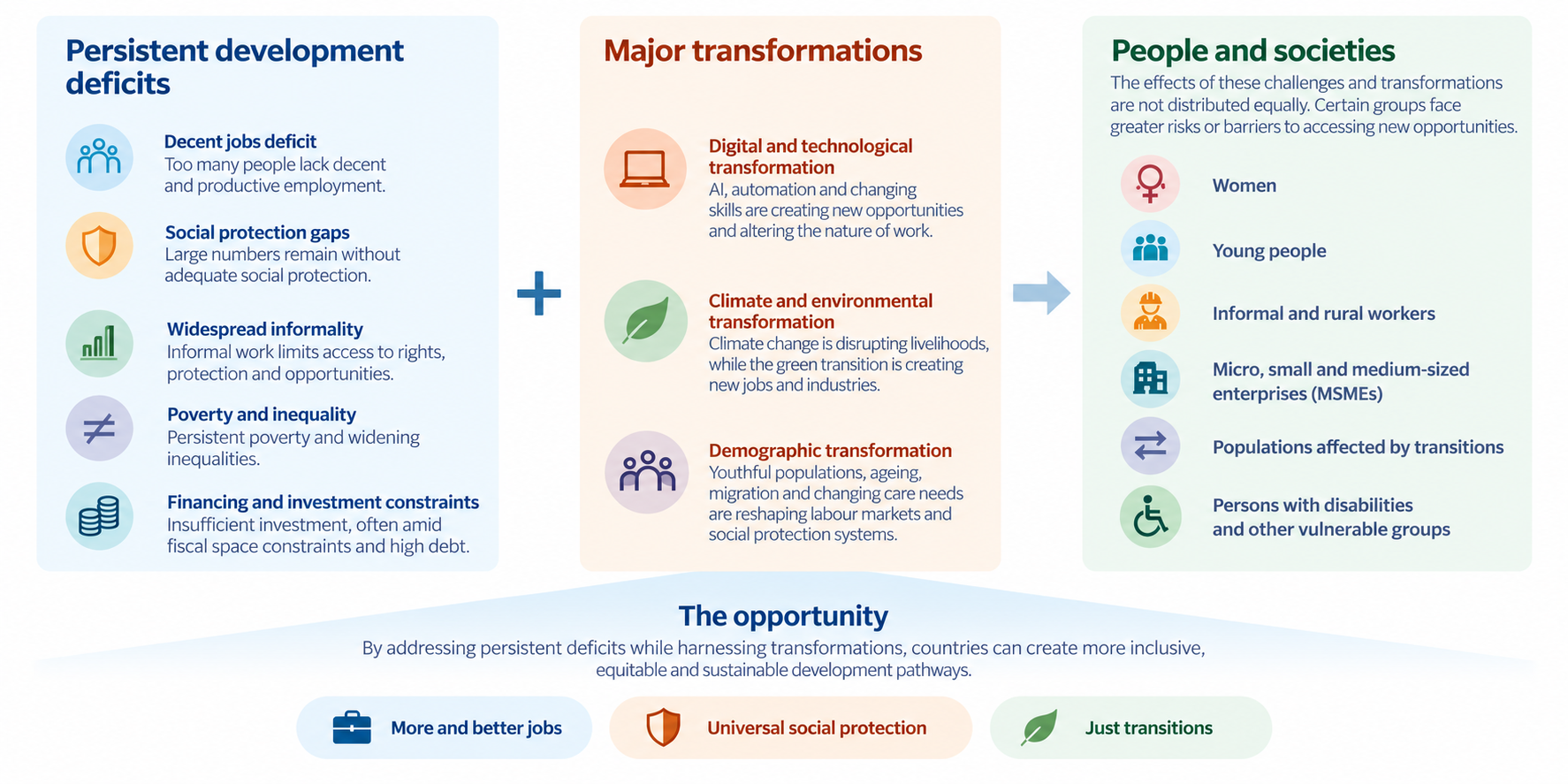
Employment, social protection, financing and the major transformations shaping economies and labour markets are closely interconnected. Progress in one area depends on choices made in others.
Addressing these challenges therefore requires solutions that work across policy areas. The Global Accelerator brings together employment and social protection policies, economic and sectoral policies, financing and investment, and institutional action around shared objectives: decent jobs, universal social protection and just transitions.
This integrated approach is at the heart of the Global Accelerator. It seeks to ensure that policies, financing and institutions reinforce one another and work towards common outcomes, rather than being designed in isolation.
The Global Accelerator responds to this development landscape through an integrated approach to jobs, social protection and just transitions.
Its three pillars — integrated national strategies and policies, integrated financing, and enhanced multilateral cooperation — are translated through the Theory of Change into five interconnected areas of action. Together, they provide pathways through which national priorities can be translated into policy and institutional change, improved financing and, ultimately, better outcomes for people and enterprises.
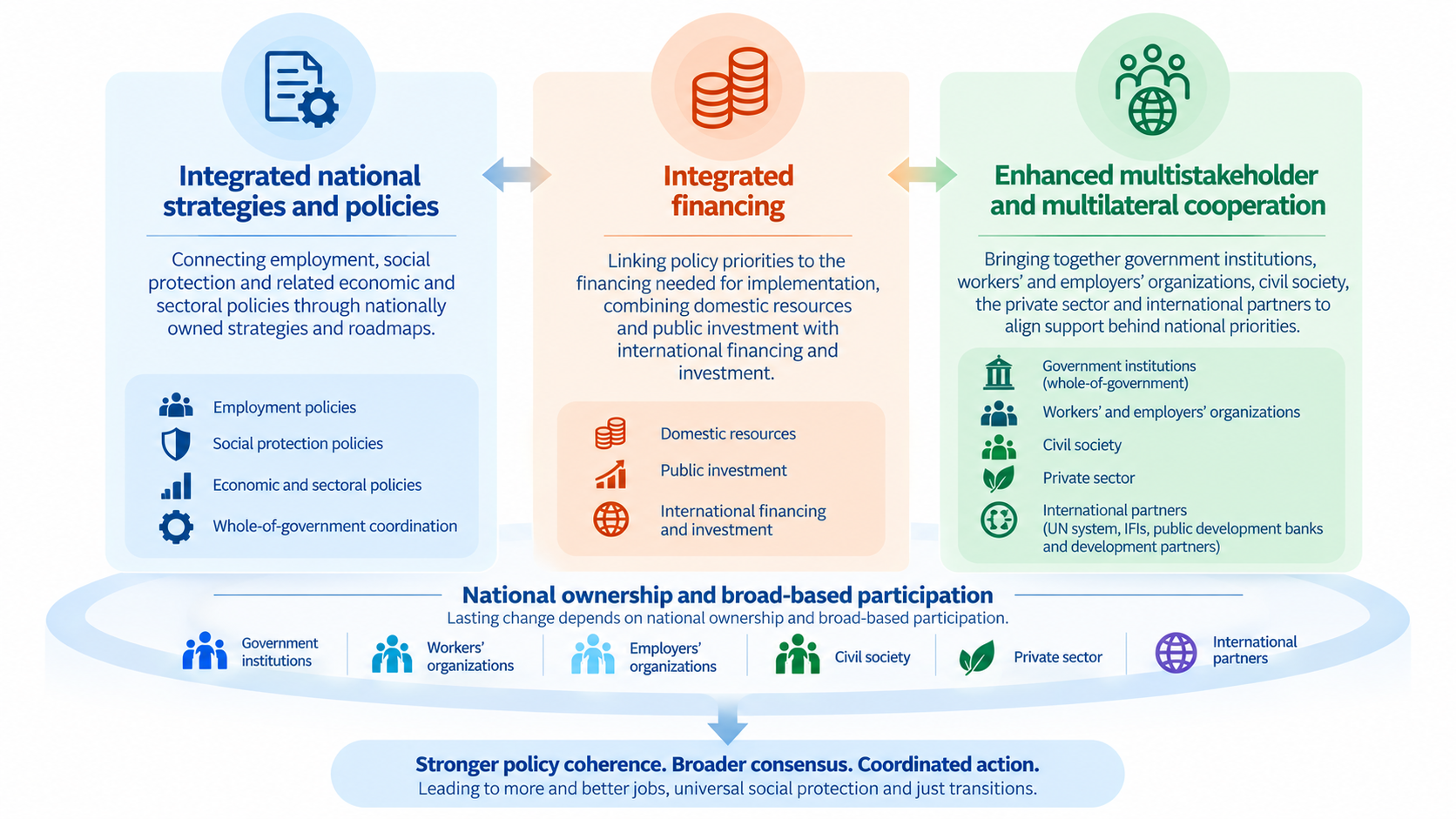
Achieving decent jobs, universal social protection and just transitions requires policies that work together across traditional sectoral boundaries.
The Global Accelerator supports countries in developing integrated policy packages that connect employment and social protection with relevant macroeconomic, fiscal and sectoral policies. The combination will differ according to national priorities — from employment and skills to formalization, social protection, productive sectors, care, and green or digital transitions.
The objective is to strengthen the positive interactions between these policies so that their combined contribution to employment, social protection and inclusion is greater than what isolated interventions could achieve.
Integrated policies need adequate and sustainable resources to move from ambition to implementation.
The Global Accelerator supports countries in developing financing frameworks that connect policy priorities with a combination of domestic and international resources. Depending on national circumstances, this can include domestic resource mobilisation, social contributions, improved allocation and management of public resources, international financing and innovative financing instruments.
It also seeks to increase the social and employment impact of wider economic and green investments, helping countries align financing and investment decisions with the priorities identified through their Global Accelerator roadmaps.
Policy and financing reforms need to translate into stronger systems and programmes that reach people and enterprises.
The Global Accelerator supports the development, expansion and implementation of employment and social protection policies, programmes and delivery systems in line with national priorities. This can include strengthening institutions, improving the reach and quality of services, extending social protection coverage, supporting employment and skills programmes, and improving the connections between systems that help people navigate work and life transitions.
The objective is to build national capacity and systems that can sustain progress beyond individual programmes and projects.
Lasting change depends on national ownership and broad-based participation.
The Global Accelerator brings together government institutions, workers’ and employers’ organizations, civil society, private sector and other national stakeholders around shared priorities. Whole-of-government coordination helps connect ministries responsible for labour and social affairs with finance, planning, economy and relevant sectoral institutions, while social dialogue helps ensure that priorities reflect the realities and needs of workers and employers.
International partners — including the UN system, international financial institutions, public development banks and development partners — can then align their technical and financial support behind this nationally owned agenda.
This creates the basis for stronger policy coherence, broader consensus and coordinated action around implementation.
Implementation creates opportunities to learn, adapt and improve.
The Global Accelerator supports the generation and use of data, evidence, knowledge and innovative tools to inform policy choices, strengthen implementation and monitor results. Experience across Pathfinder Countries can help identify what works in different contexts, support peer learning and refine approaches over time.
This continuous feedback between evidence, implementation and learning helps countries adapt policies and investments as circumstances change and strengthens the Global Accelerator’s collective knowledge base.
Together, these five interconnected pathways are intended to create change at several levels.
More coherent policy packages, stronger legal and institutional frameworks and greater capacity to design and implement integrated approaches.
Expanded fiscal space, stronger budgeting and financing systems, and greater mobilisation and alignment of resources with national priorities.
Improved livelihoods, greater social equity and tangible progress towards decent work, expanded social protection and just transitions.
The results framework provides a common basis for monitoring these changes across Pathfinder Countries while allowing national results and indicators to reflect different country contexts and priorities.
The Global Accelerator Theory of Change and Results Framework sets out the pathways through which the initiative seeks to contribute to change and provides a common framework for monitoring progress across countries and at the global level.